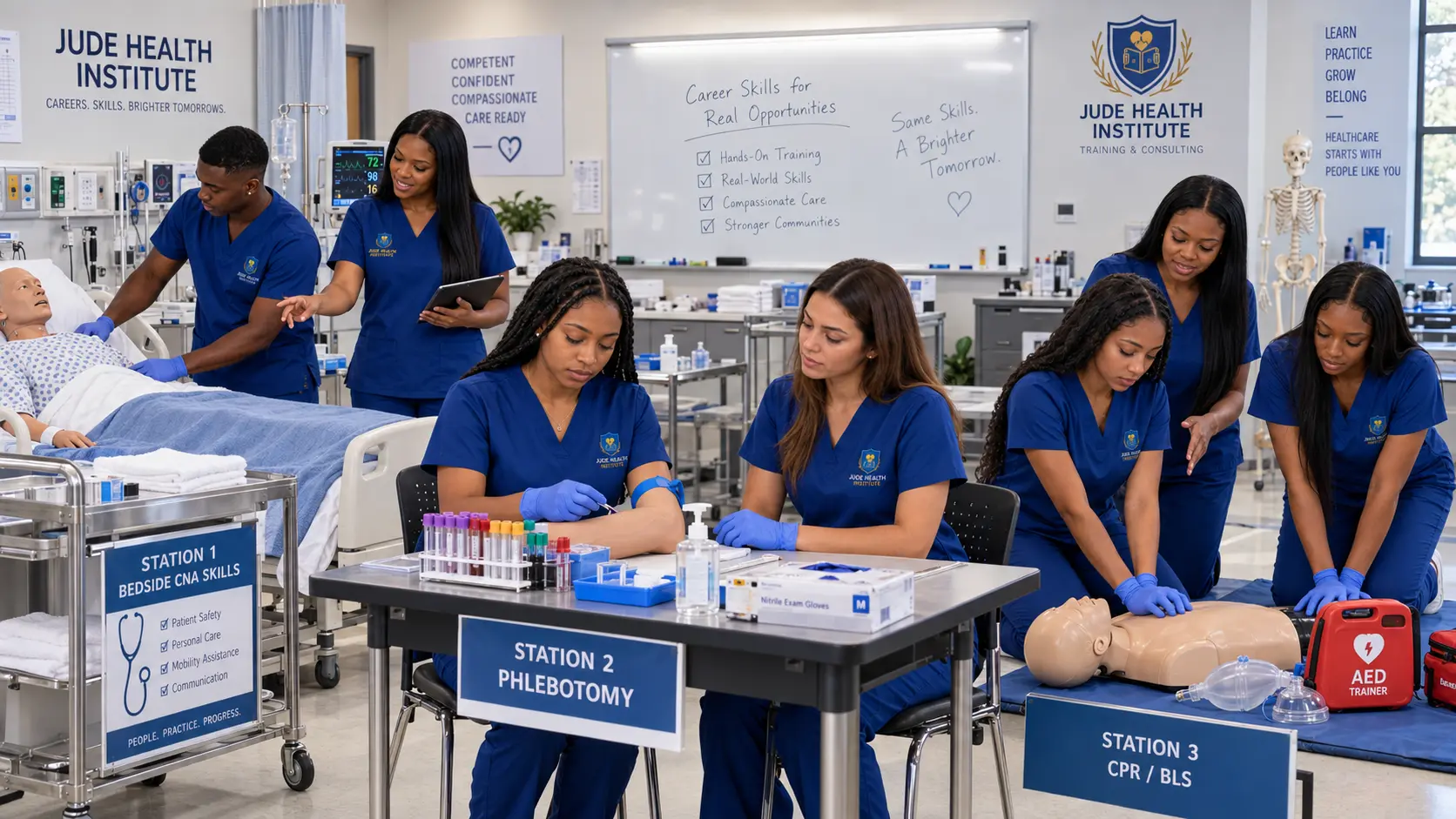
Adult, child and infant CPR, use of an AED, and relief of foreign-body airway obstruction
Team-based resuscitation roles, compression quality and bag-mask ventilation
Real Google reviews
What our students say
Unedited words from students at the Orlando centre. Nothing here is written by us.
4.950 Google reviews
R
Rose F.
Google review
“Great training, I learned so much. … All the instructors are nurses with experience.”
M
Maita C.
Google review
“Good school with great instructors. … I recommend anyone who’s interested in becoming a CNA or who just needs a review to go there without hesitation.”
F
France B.
Google review
“I love the school, excellent teachers. Bilingual class is very good. I felt comfortable during the whole session. Thank you”
A
Abria A.
Google review
“The best school, Ms. Jude is patient and takes her time to make sure everyone understands. 10/10 recommend”
R
Ralph A.
Google review
“I feel proud that I chose to come to Jude Health Institute. The professors do their classes well. The students understand the lessons. We are pleased to be part of your class”
D
Dina S.
Google review
“I love love the CNA prep course. Love the teachers. I talk about the program wherever I go. … I didn’t regret going.”
M
Marie D.
Google review
“I have no words! We learned so much. … They offer class in English, Creole and Spanish.”
E
Evelyne F.
Google review
“I would recommend this healthcare training to anyone who is looking for a great healthcare career path. I did not regret coming”
R
Rabel B.
Google review
“Good school great teacher. Ms. Judy is the best. … I learned so much”
M
Michaelle B.
Google review
“I love the school, I love my Teacher Judy, she makes it easy to learn.”
Stacking is the practical name for building a healthcare career out of several small, separately awarded credentials rather than one large qualification. The US Department of Labor describes a credential as stackable when it is part of a sequence that can be accumulated over time to build up a person’s qualifications along a career pathway. That is the idea here: three distinct pieces of evidence that you can be trusted with patients, with needles, and in an emergency.
The reason employers respond to it is scheduling, not sentiment. A hospital floor, a dialysis centre, a long-term care facility and a plasma donation site all run on coverage. Someone who can take vital signs, assist with activities of daily living, draw a clean tube and lead a compression cycle until the code team arrives is one person a supervisor can place in more than one gap. Entry-level hiring managers rarely get to pick the perfect candidate — they pick the one who reduces the number of people they have to roster.
These three fit together because they are complementary rather than overlapping. CNA work is about the whole patient: mobility, hygiene, feeding, dignity, observation, documentation. Phlebotomy is a discrete technical procedure with a hard right answer. CPR and BLS are the emergency layer underneath both. Because they do not compete, each one widens the set of job postings you can answer instead of just deepening one.
This is the most misunderstood point about any package like this, so it is worth stating plainly. You are buying instruction, practice and preparation. You are not buying certificates. Each of the three components sits inside its own system, run by its own external organisation, with its own application, its own fee and its own pass or fail decision.
The CNA credential is issued by the Florida Board of Nursing after you pass the competency examination administered by Prometric. Examination preparation and a Board-approved training programme are two different products — if you specifically need the approved-programme route, ask us before you pay anything.
Phlebotomy certification is granted by a national certifying body after its own examination and eligibility review. Florida does not license phlebotomists at state level, which moves the gatekeeping to employers and to those national bodies; hospitals and reference laboratories commonly ask for a recognised certification. No state licence does not mean no credential needed.
A CPR or BLS card is issued under the standards and authority of the awarding organisation. We prepare you for all three of these processes and we award none of them.
Three subjects at once is a real load. You are learning whole-patient care, a precise technical procedure and emergency response in parallel, and they draw on different kinds of attention. Taking the components one at a time spreads the cost, lets you start earning after the first credential, and reduces the risk of failing an examination because your focus was split. The trade-off is a longer overall timeline.
The cost is also concentrated rather than spread. And because each component leads to a separate external process, there are three applications, three sets of fees and three sets of dates to keep track of — none of which we control.
We would rather say this plainly than have you find it out after enrolling. If one course is the right answer for you, ask us for that instead.
The figures in the card are the US Bureau of Labor Statistics’ own. For nursing assistants and orderlies it counts about 1,558,700 jobs in 2025 and projects growth of 3 per cent from 2025 to 2035 — about as fast as the average for all occupations. Most of the yearly openings come from replacing workers who leave the occupation.
For the laboratory side, the Bureau counts about 143,900 phlebotomist jobs in 2025 and roughly 18,000 openings a year. It also notes that phlebotomists typically enter the occupation with a postsecondary non-degree award, which is why a workshop-plus-certification route is a normal entry path rather than an unusual one.
Local conditions differ from national averages, and you should know that before you commit. In the Bureau’s May 2025 release for the Orlando-Kissimmee-Sanford metropolitan area, the average hourly wage across all occupations was $29.76 against $33.54 nationwide. Healthcare support work is a smaller share of local jobs than it is nationally, and its local pay sits well below the area’s all-occupation average.
Read plainly: Orlando’s labour market is weighted towards hospitality, local healthcare support wages sit below the area’s all-occupation average, and no credential or combination of credentials guarantees a job, an interview or a wage. We publish these figures rather than a success story because you can check them.
National figures, not a forecast for you
Orlando healthcare support pay sits below the area’s average
A smaller share of local jobs than nationally
No credential guarantees a job, an interview or a wage
What the state sets, and what is simply practical. Anything set by the state should be confirmed against the source, because it changes.
Set by the state or a certifying body
Florida CNA examination eligibility is set by the Florida Board of Nursing, which describes routes including completion of an approved training programme, holding a high school diploma or equivalent, or being at least 18 years of age — in each case with a passing score on the competency examination.
Applicants for initial CNA certification must submit fingerprints through a Livescan provider to the Florida Department of Law Enforcement.
Prometric asks for a complete testing application and fees well in advance of the requested test date. Check the current notice period in its Florida bulletin.
Phlebotomy certification eligibility, documented draw counts and exam fees are set by whichever certifying body you apply to.
Practical
Scrubs and closed-toe, non-slip shoes for skills practice.
Government-issued photo identification.
A watch with a second hand is useful for measurement skills.
Ask us for the full materials list before you enrol — we would rather tell you up front than have you discover a cost later.
Read this
What we are and are not
Published in full rather than buried in a footer. If another provider will not tell you where its limits are, that is worth noticing.
Common questions
Frequently asked questions
Straight answers to what students ask us most, including the ones other providers avoid.
Not answered here? Ask us directly. If we hear a question more than once it ends up on this page.
No. It prepares you for the examination. In Florida the CNA credential is issued by the Florida Board of Nursing after you pass the competency examination administered by Prometric. Examination preparation and a Board-approved training programme are not the same thing, and no provider can guarantee a pass. If you need the approved-programme route specifically, ask us before you enrol.
Who actually awards each certification?
Three different organisations. The CNA credential comes from the Florida Board of Nursing after the Prometric-administered examination. Phlebotomy certification comes from a national certifying body with its own eligibility rules and exam. A CPR or BLS card is issued under the standards of the awarding organisation. We prepare you for all three and award none of them.
Is it cheaper than booking the three separately?
We are not going to claim a saving we have not shown you. The package is $1,500 plus a $75 registration fee. Whether that is less than three separate enrolments depends on the individual course prices and on which external examination fees are included. Ask us for the itemised comparison in writing, and ask specifically which third-party fees you would still owe.
Can I take them one at a time?
Often that is the smarter choice, and we will tell you so if it applies to you. Taking the components in sequence spreads the cost, lets you start earning after the first credential, and reduces the risk of a split-focus failure. The trade-off is a longer timeline. Ask us which components are available individually and at what price.
Do I need the CNA before the phlebotomy workshop?
There is no general rule requiring it. They are independent credentials with independent gatekeepers, and many people certify in phlebotomy with no nursing assistant background — the Bureau of Labor Statistics notes phlebotomists typically enter with a postsecondary non-degree award. Ask us how the components are sequenced and whether that order is flexible.
Is phlebotomy licensed in Florida?
Florida does not issue a state phlebotomy licence. In practice that shifts the requirement to employers, and hospitals and laboratories commonly ask for a recognised national certification. So no state licence does not mean no credential needed. Check which certification is named in the job postings you are actually targeting before choosing a certifying body.
What is the total cost, and are examination fees included?
The package is $1,500 plus a $75 registration fee. Outside examination, background-screening, certification, textbook, uniform and supply fees may not be included — a complete fee breakdown is provided before enrolment. Ask us to confirm in writing which third-party fees are covered, because those are charged by other organisations, not by us.
What if I already hold a current CPR card?
Then part of this package is redundant for you right now, and you should raise it with us before paying for all three components. Cards from the major awarding organisations are typically valid for two years from issue. Tell us what you hold and when it expires and we will tell you honestly whether the package still makes sense.
Where this comes from
Sources
Every regulatory statement on this page traces to a primary source. We would rather you checked them than took our word for it — and requirements change, so confirm your own before you rely on anything here.
Approximately 4–8 weeks · In person, with supplemental learning materials
Prepare for the Florida CNA written examination and clinical-skills evaluation through guided instruction, hands-on practice and realistic exam preparation.
20 instructional hours · Classroom instruction, demonstrations and supervised skills practice
Develop practical blood-collection skills and prepare for a national phlebotomy certification examination through focused instruction and supervised hands-on practice.