Coming soon
Healthcare Professional-Development Workshops
In person and virtual
Practical, professional and business skills for healthcare workers who want to grow beyond the classroom.
Professional Development
Rebuild bedside confidence with supervised simulation practice: catheters, IV skills, injections, wound care, sterile technique and assessment.
4.9 · 50 Google reviews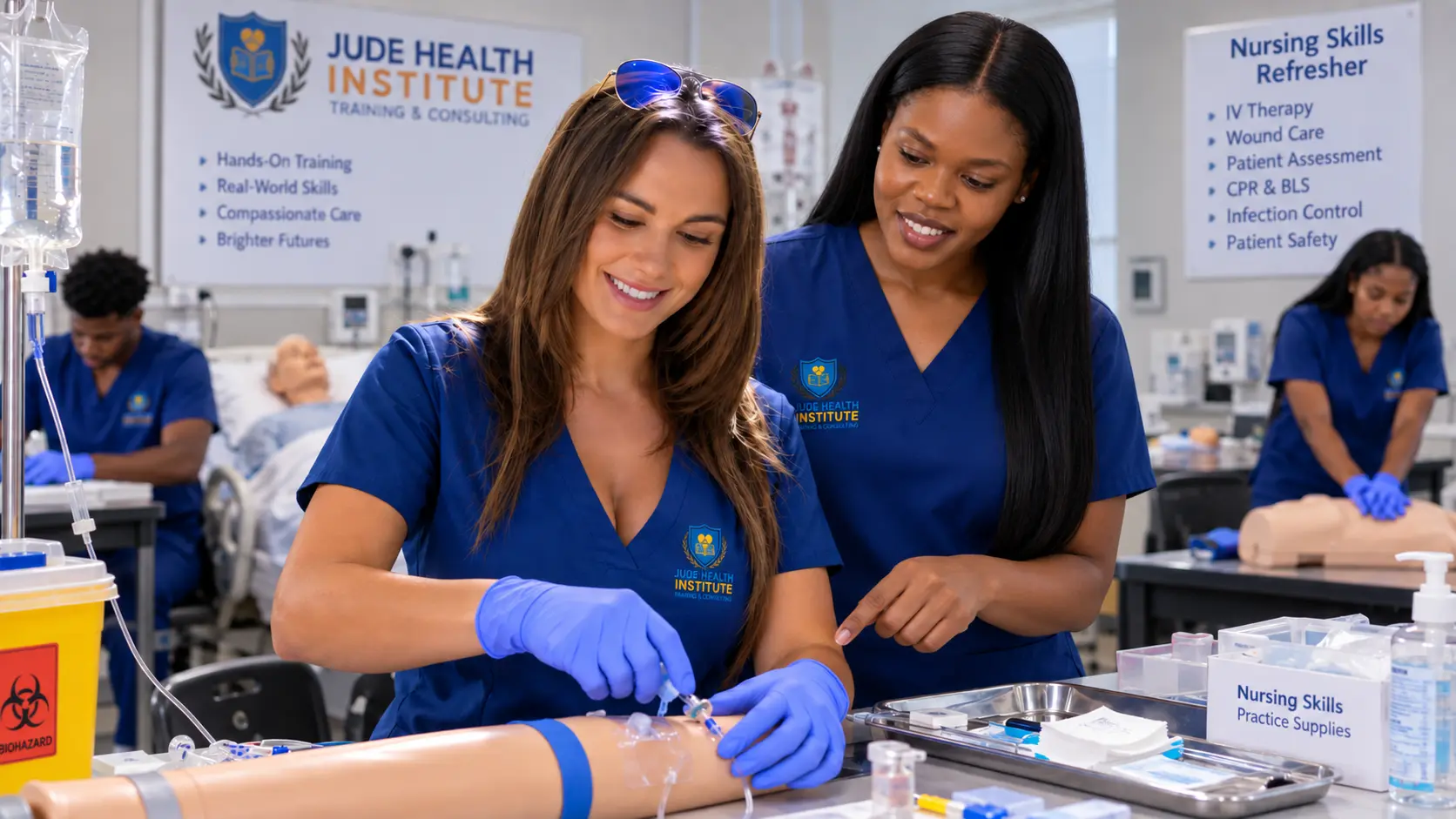
Illustration of what this course covers, not a photograph of our centre. Visit us on Lake Ellenor Drive, Orlando, to see the real classroom.
Overview
A hands-on workshop for nursing students, graduates, new nurses and experienced nurses who want additional practice with essential bedside skills. Participants practise in a supportive skills laboratory using mannequins, simulation arms and task trainers. There are no live patients.
It is for nurses who know the steps but whose hands have slowed: after a career break, before a practical assessment at interview, or when moving into a setting with different equipment. It is practice time with feedback. It carries no regulatory weight, and the sections below say exactly where its limits are.
Curriculum
The concrete skills covered, so you can compare this against any other course you are considering.
Who it is for
If more than one of these describes you, it probably is. If the other side describes you better, call us and we will point you elsewhere.
This is probably right for you if
Another course would serve you better if
Real Google reviews
Unedited words from students at the Orlando centre. Nothing here is written by us.
4.950 Google reviews
Read all 50 reviews on Google · or call (407) 606-7964 to speak with an advisor.
Returning to practice
People step away from bedside nursing for ordinary reasons: parental leave, caring for a relative, injury, credentialing delays, a spell in a non-clinical role. What almost everyone reports on the way back is the same — not that they have forgotten nursing, but that their hands have got slow and their nerve has gone.
That matches the research on skill retention. A 2019 review of simulation training notes that technical skills can begin to deteriorate within about two months when they are not used or practised, and a 2021 systematic review found procedures learned in simulation declining over the following months in most studies. Extend that to cannulation or dressing technique and the pattern is familiar: you know the steps, but your hands have lost the sequence and the tempo.
Equipment familiarity fades for a different reason: devices and electronic charting move on while you are away. So does composure while being watched. Performing with a preceptor or an interview panel standing over you is a distinct skill, and often the first to go.
Clinical reasoning tends not to fade. Assessment logic, putting a deteriorating patient ahead of a demanding one, knowing when something is simply wrong — these last. Returning nurses are rarely relearning how to think; they are relearning how to move. Supervised practice addresses that. It cannot certify competence, replace clinical hours in a regulated programme, or change your licence status.
Read this first
This is practice time. It is not a credential, and it carries no regulatory weight.
Jude Health Institute is not accredited, not state-approved and not a Board-approved remedial provider. Attendance satisfies no Board order, disciplinary requirement, probationary condition, reinstatement condition or reactivation requirement. It produces no competency sign-off that an employer or the Board must accept, and it does not guarantee employment.
Three different things get loosely called a refresher, and confusing them costs people money. If a Board order or licensure letter requires you to complete remediation, nothing here will discharge that obligation.
Board orders
Do not enrol here to satisfy a Board requirement. The steps here are the ones that protect you, and none of them involves us.
The Board’s contact details are on its website, linked in the sources below. Ask for its answer in writing: a written confirmation is what you will rely on if the question is ever raised again. This is general information, not legal advice.
Your licence
Florida RN and LPN licences renew every two years under section 464.013 of the Florida Statutes, which lets the Board require continuing education by rule. A licence not renewed by its expiration date becomes delinquent, and then null and void two years after expiration. The Board states that a null and void licence cannot be reactivated: you must reapply and meet current requirements.
The critical provision for inactive licences is Rule 64B9-6.003. A licensee with no active licence in good standing elsewhere, whose Florida licence has been inactive for five years or more, must complete a nursing remedial course under Rule 64B9-3.0025, with a clinical component appropriate to the licence level. That is the Board-approved course of 80 didactic and 96 clinical hours, not a workshop.
On the examination route, section 464.008 requires an applicant who fails the NCLEX three consecutive times to complete a Board-approved remedial course before re-examination. On the disciplinary route, the Board may impose penalties under section 456.072, including remedial education, continuing education, re-examination or supervised practice. Where impairment is alleged, referral is to the Intervention Project for Nurses.
Jude Health Institute has no role in any of these pathways. This was checked on 18 September 2026; rules change, so verify anything that affects you directly with the Board.
Back to work
Returning to practice is a paperwork problem and a confidence problem at once. The paperwork belongs to the Board and to employers’ credentialing teams. The confidence problem is what practice time addresses, and it matters because nursing interviews are often no longer conversations alone. Employers commonly use medication calculation tests, scenario questions and observed skills stations — a dressing change, an IV set-up, a safe transfer — and candidates who have not touched the equipment in years can underperform relative to their real clinical judgement.
Moving between settings raises it differently. Acute care, long-term care, rehabilitation, home health and community nursing each demand a different skill mix and pace. A nurse with fifteen years in intensive care can be unsteady on wound care in long-term care, and the reverse is just as true.
No workshop can promise an outcome. Hiring rests with employers, licensure rests with the Board, and competence is judged by those who supervise you in practice.
Choose a format
The same teaching, in the shape that fits your week. An advisor will help you pick if you are unsure.
2 hours
199
One skills category: catheter, IV, injections, wound care, or assessment and documentation
6 hours
597
Catheter insertion, peripheral IV, injection techniques, basic wound care, sterile technique, documentation and communication
2 hours, one-to-one
199
Instruction on skills you select, with an individual practice plan
12 hours over two days
999
Full skills-laboratory experience, repeated practice, skills workbook and certificate of completion
Before you start
What the state sets, and what is simply practical. Anything set by the state should be confirmed against the source, because it changes.
Read this
Published in full rather than buried in a footer. If another provider will not tell you where its limits are, that is worth noticing.
Common questions
Straight answers to what students ask us most, including the ones other providers avoid.
Not answered here? Ask us directly. If we hear a question more than once it ends up on this page.
(407) 606-7964No. If the Board, a Final Order or a probation condition requires remediation or any course, this workshop does not satisfy it. Only a provider on the Board’s approved remedial courses list can, and only for the requirement it was approved for.
No. Reinstatement, reactivation and reapplication are decided by the Florida Board of Nursing under Chapter 464 of the Florida Statutes and Chapter 64B9 of the Florida Administrative Code. No workshop and no private provider can reinstate a licence or shorten that process.
No, and nothing on this site claims otherwise. Check any provider’s approval yourself on the Florida Board of Nursing’s own website before you pay anyone.
No CE credit is claimed for this workshop. Florida CE must come from providers approved by the Board or by a recognised national body. If you need CE hours for renewal, get them from an approved provider and check that approval before you pay.
No. No outside provider can sign off competence on an employer’s behalf. Employers assess competence themselves, through orientation, preceptorship and their own validation. You receive a certificate of completion, which records that you attended.
No. Rehearsing a sequence on a manikin is practice, not certification. BLS and ACLS cards come from recognised training organisations, and employers check the issuing body, so book those separately.
Where this comes from
Every regulatory statement on this page traces to a primary source. We would rather you checked them than took our word for it — and requirements change, so confirm your own before you rely on anything here.
No obligation · Speak with an advisor
Tell us where you are in your career and an advisor will come back with confirmed dates, the full cost and what to bring.
9:00am – 5:00pm, Monday to Friday
Two quick steps — tell us what you need, then how to reach you.

JHI Advisor
Jude Health Institute
Talk to an advisor about courses, schedules, costs and your next step. Pick a day to start.
Free · 30 minutes · No obligation