Jude Health Institute

CPR, BLS, AED and First Aid

CPR, BLS, AED and First Aid

Learn the lifesaving skills needed to respond confidently during cardiac, breathing and first-aid emergencies.

4.9 · 50 Google reviews
  • DeliveryIn person or blended, depending on the course
  • LanguagesEnglish, Haitian Creole, Spanish
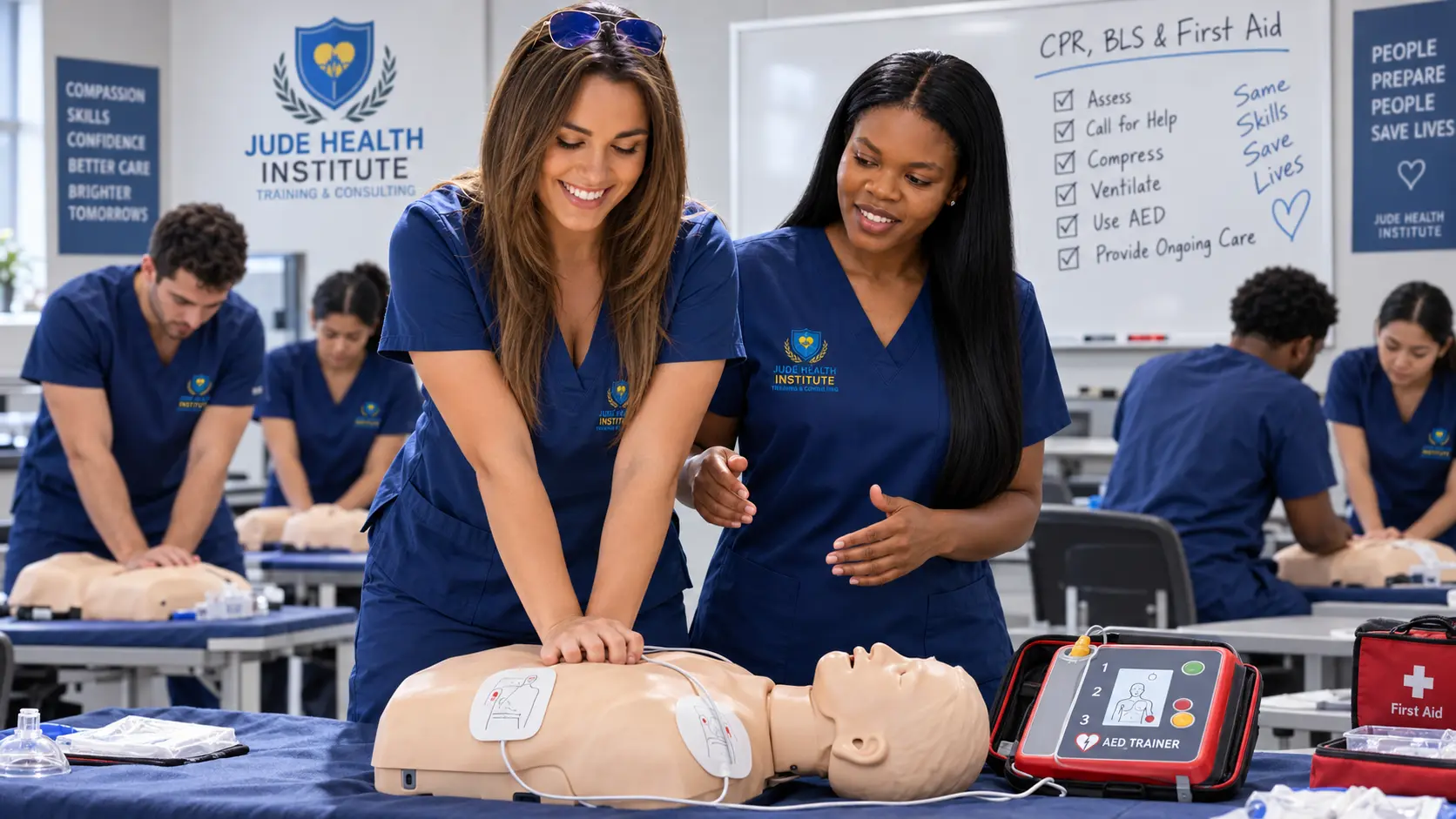
Illustration: A student practises chest compressions on a manikin fitted with AED trainer pads while an instructor coaches her

Illustration of what this course covers, not a photograph of our centre. Visit us on Lake Ellenor Drive, Orlando, to see the real classroom.

Overview

About this course

CPR and BLS classes are available. Course options, dates and certification details will be posted once final authorization is confirmed.

To ask which classes are running, and to be told first when the schedule is published, contact us directly.

Curriculum

What you will learn

The concrete skills covered, so you can compare this against any other course you are considering.

  • Scene safety, personal protective equipment and activating the emergency response system
  • Recognising cardiac arrest, agonal breathing and unresponsiveness, and checking for a pulse
  • Adult high-quality chest compressions — hand position, depth, rate, full chest recoil and minimising interruptions
  • Child and infant CPR, including compression technique differences and paediatric compression-to-ventilation ratios
  • Rescue breathing with a barrier device, pocket mask and bag-mask device, including two-rescuer technique
  • Compression-only CPR for bystanders who are untrained or unwilling to give breaths
  • AED use: pad placement, adult versus paediatric pads and settings, shock delivery and immediate resumption of compressions
  • Choking relief for responsive adults and children, alternating back blows with abdominal thrusts
  • Infant choking relief using back blows and chest thrusts — abdominal thrusts are not used in infants
  • Team dynamics, closed-loop communication, role assignment and switching compressors
  • Opioid-associated emergency recognition and the role of naloxone
  • First aid competencies where the course includes them: bleeding control, wounds, burns, splinting, seizures, stroke and heart attack recognition, anaphylaxis, diabetic emergencies, heat and cold illness

Who it is for

Is this the right course for you?

If more than one of these describes you, it probably is. If the other side describes you better, call us and we will point you elsewhere.

This is probably right for you if

  • Nurses, CNAs and HHAs
  • Medical assistants and phlebotomists
  • Healthcare students
  • Childcare professionals
  • Business employees and community members

Another course would serve you better if

  • You need ACLS, PALS, NRP, EMT or paramedic training — those are different courses with different prerequisites.
  • Your employer requires a specific awarding organisation’s card. Confirm which cards are issued before booking anything.
  • Recent injury, surgery, pregnancy complications or mobility limits affect kneeling and floor-level work. Skills testing is physical — discuss adaptations with us in advance.
  • You are looking for a certificate with no hands-on skills check. Those exist, and they are widely rejected by employers.

Real Google reviews

What our students say

Unedited words from students at the Orlando centre. Nothing here is written by us.

4.950 Google reviews

  • Rose F.

    Google review

    “Great training, I learned so much. … All the instructors are nurses with experience.”
  • Maita C.

    Google review

    “Good school with great instructors. … I recommend anyone who’s interested in becoming a CNA or who just needs a review to go there without hesitation.”
  • France B.

    Google review

    “I love the school, excellent teachers. Bilingual class is very good. I felt comfortable during the whole session. Thank you”
  • Abria A.

    Google review

    “The best school, Ms. Jude is patient and takes her time to make sure everyone understands. 10/10 recommend”
  • Ralph A.

    Google review

    “I feel proud that I chose to come to Jude Health Institute. The professors do their classes well. The students understand the lessons. We are pleased to be part of your class”
  • Dina S.

    Google review

    “I love love the CNA prep course. Love the teachers. I talk about the program wherever I go. … I didn’t regret going.”
  • Marie D.

    Google review

    “I have no words! We learned so much. … They offer class in English, Creole and Spanish.”
  • Evelyne F.

    Google review

    “I would recommend this healthcare training to anyone who is looking for a great healthcare career path. I did not regret coming”
  • Rabel B.

    Google review

    “Good school great teacher. Ms. Judy is the best. … I learned so much”
  • Michaelle B.

    Google review

    “I love the school, I love my Teacher Judy, she makes it easy to learn.”

Read all 50 reviews on Google · or call (407) 606-7964 to speak with an advisor.

Choosing a course

Which course do you actually need?

“CPR class” is not one product. It is a family of courses with different audiences, different skill lists and different cards, and the differences matter because the wrong card gets rejected at onboarding. Before booking anything, get the requirement in writing from whoever will check it — your employer’s HR or clinical education department, your licensing board, your degree programme or your certifying agency.

The first tier is lay-rescuer training, for people with little or no medical background who need a card for work or simply want to be ready. Separately there are awareness sessions that deliberately do not certify anyone. If a job, licence or programme application requires proof, an awareness session will not satisfy it.

The second tier is BLS for healthcare providers. Its distinguishing content is not harder CPR — it is high-performance, multi-rescuer resuscitation: team dynamics and role assignment, two-rescuer ratios, bag-mask ventilation and pulse checks. This is the level most clinical employers, nursing programmes and allied-health programmes mean when they write “CPR required”.

The third tier is advanced life support — ACLS and its paediatric counterpart PALS — for clinicians who direct or participate in managing cardiac arrest and other cardiopulmonary emergencies. These assume rhythm recognition, drug therapy and post-arrest care. Neither is a substitute for a CPR card in a non-clinical role, and neither is an entry-level course.

The failure mode is predictable. A CNA applicant books the short lay-rescuer course because it is cheaper, and is told to redo it as BLS. A fitness instructor books BLS because it sounds more serious, and pays for team content they will never use. A parent books BLS when a family course was exactly right.
Cards and renewal

How certification and card validity work

Cards from the major awarding organisations are typically valid for two years, and commonly expire at the end of the month of issue. There is generally no published grace period, so treat the expiry month as a hard deadline and book a renewal a month or two early rather than after it lapses. Renewal and initial courses usually cover the same skills at a different pace, not to a lesser standard.

The single most important mechanical point is that a hands-on skills component is normally required. For courses that include psychomotor skills such as CPR, a student generally has to complete an in-person or supervised skills session before a card can be issued — which is why blended-learning products pair online coursework with a practical session. Purely online instant-certificate products exist, but they are not equivalent and are frequently rejected.

Finally, employers may name an awarding organisation. It is common and lawful for a hospital, agency or school district to specify one organisation’s card and to decline another. A card is only useful if the organisation checking it accepts it, so verify the accepted awarding body and the exact course title before you enrol in anything.

Legal protection

If you help someone, where do you stand?

This is one of the most common reasons people hesitate, so it is worth answering. Florida’s Good Samaritan Act and its Cardiac Arrest Survival Act provide civil-liability immunity for people who render emergency care in good faith, including those who use or attempt to use an AED in a perceived medical emergency. There are exceptions for wilful misconduct, gross negligence and reckless disregard.

That is general information rather than legal advice, and the statutes are linked below so you can read the wording yourself. The practical point stands: the law is written to encourage a trained bystander to act.

Before you start

Requirements and what to bring

What the state sets, and what is simply practical. Anything set by the state should be confirmed against the source, because it changes.

Set by whoever checks your card

  • The exact course name your employer, programme or board requires. Bring the email, policy or checklist that states it.
  • For workplaces, 29 CFR 1910.151(b) requires adequately trained first-aid personnel where no infirmary, clinic or hospital is in near proximity.
  • Florida child care standards require staff with current first aid and infant and child CPR certification present whenever children are in care. Adult-only CPR does not satisfy this.
  • Florida CNA rules require in-service training every two years with CPR among the required topics; long-term care employers usually specify the card.

Practical

  • Government-issued photo identification, plus your existing card if you are renewing.
  • Comfortable clothing suitable for kneeling and working at floor level.
  • Willingness to be assessed on physical skills.
  • Any accommodation request submitted to us in advance, in writing.

Read this

What we are and are not

Published in full rather than buried in a footer. If another provider will not tell you where its limits are, that is worth noticing.

Common questions

Frequently asked questions

Straight answers to what students ask us most, including the ones other providers avoid.

Not answered here? Ask us directly. If we hear a question more than once it ends up on this page.

(407) 606-7964
Is an online-only card accepted?

Usually not for employment. For courses involving hands-on skills such as CPR, the major awarding organisations require a practical skills session before a card is issued, and online-only certificates are widely rejected by hospitals, schools and licensing bodies. If a vendor promises certification with no skills check, verify acceptance with your employer before paying.

How long is a card valid?

Typically two years from issue, commonly expiring at the end of the issuing month. Because there is generally no published grace period, treat the expiry month as a hard deadline. Book a renewal a month or two early rather than letting it lapse, since an expired card usually means retaking the full course rather than a shortened update.

What is the difference between CPR and BLS?

CPR is the skill. BLS is a specific healthcare-provider course level that includes CPR plus pulse checks, bag-mask ventilation, two-rescuer ratios and team dynamics. Lay-rescuer courses teach CPR and AED use without the team-based provider content. When a clinical employer writes “CPR required”, they almost always mean BLS.

Will my employer accept this?

Only your employer can answer that, and you should get it in writing before paying for any course anywhere. Many hospitals, agencies and school districts specify a particular awarding organisation’s card. Ask them for the exact course title, which awarding bodies they accept, and whether a blended-learning format is acceptable to them.

Do I need adult or paediatric CPR?

It depends who you care for. Florida child care standards require current first aid and infant and child CPR certification for staff, so adult-only training will not satisfy a licensing inspection. Most modern first aid, CPR and AED courses cover adult, child and infant together, but confirm the paediatric scope is explicitly named on the card.

Is first aid included with CPR?

Not automatically. CPR with AED, and first aid with CPR and AED, are separate products, and provider-level BLS courses typically do not include general first aid such as bleeding control, burns and splinting. If your workplace first-aid programme or job description names first aid, check that the course title includes it rather than assuming.

What does OSHA actually require of my workplace?

29 CFR 1910.151(b) requires adequately trained first-aid personnel where no infirmary, clinic or hospital is in near proximity. OSHA interpretations treat that as roughly three to four minutes of emergency response time in higher-hazard workplaces, and up to about fifteen minutes in low-hazard settings such as offices. Some industry-specific standards are stricter.

When will you publish class dates and course options?

CPR and BLS classes are available. Course options, dates and certification details will be posted after final authorization is confirmed. We are deliberately not publishing a schedule or naming a branded course before then. Call us and we will tell you exactly what is available today, without guessing at what is not.

No obligation · Speak with an advisor

Ask us anything about CPR, BLS and First Aid

Tell us where you are in your career and an advisor will come back with confirmed dates, the full cost and what to bring.

Call (407) 606-7964

9:00am – 5:00pm, Monday to Friday

Request the next start date

Two quick steps — tell us what you need, then how to reach you.

What are you looking for?
How should we reach you?

By sending this enquiry you agree to our Terms and Privacy Policy.

We reply during office hours, 9:00am – 5:00pm, Monday to Friday.