Jude Health Institute

Phlebotomy Skills Workshop

Phlebotomy Skills and National Exam Preparation Workshop

Develop practical blood-collection skills and prepare for a national phlebotomy certification examination through focused instruction and supervised hands-on practice.

4.9 · 50 Google reviews
  • Length20 instructional hours
  • DeliveryClassroom instruction, demonstrations and supervised skills practice
  • LanguagesEnglish, Haitian Creole, Spanish
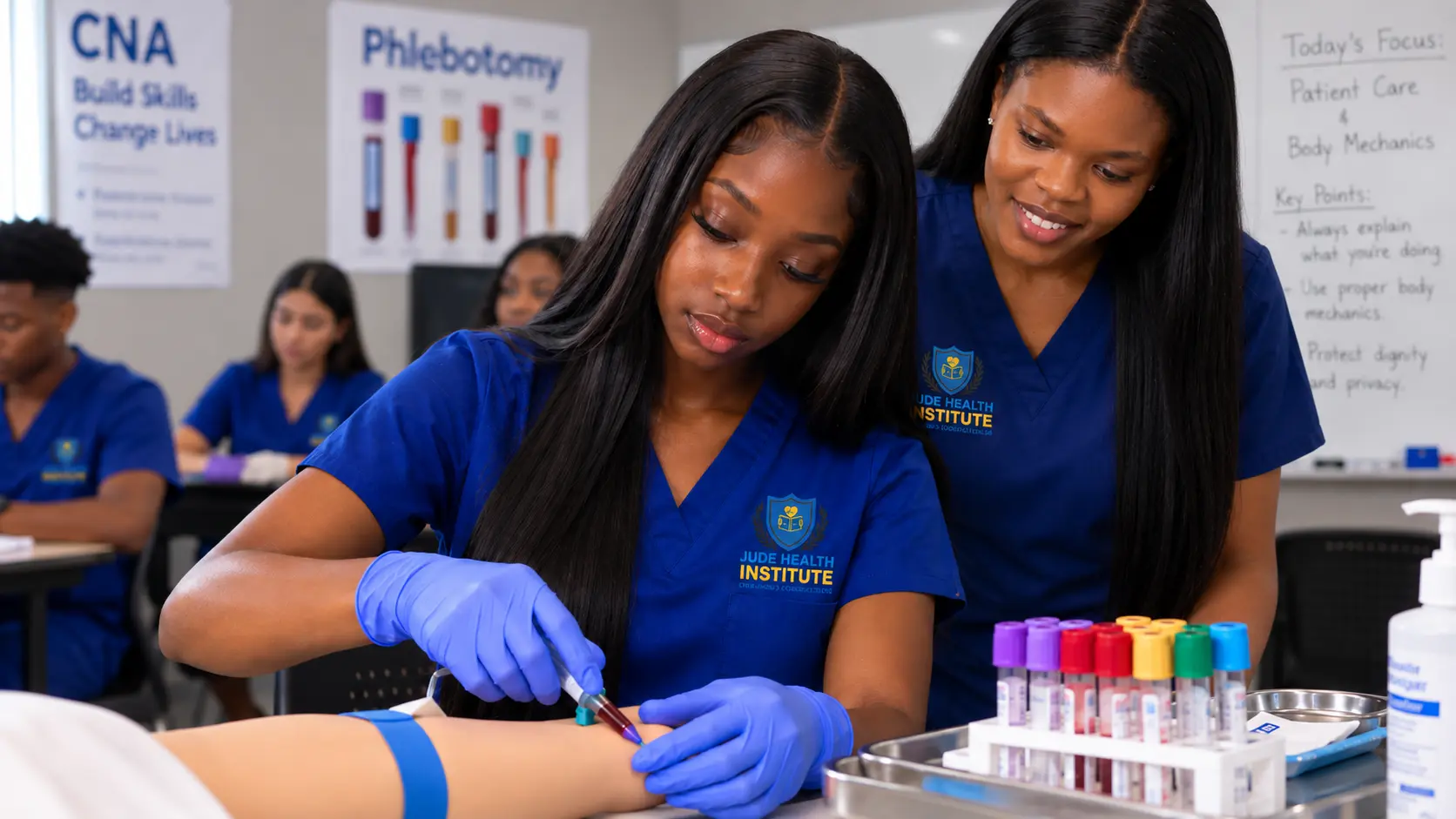
Illustration: A gloved student practises a blood draw on a training arm, with colour-coded tubes in a rack and an instructor looking on

Illustration of what this course covers, not a photograph of our centre. Visit us on Lake Ellenor Drive, Orlando, to see the real classroom.

Curriculum

What you will learn

The concrete skills covered, so you can compare this against any other course you are considering.

  • Patient identification with two identifiers, requisition verification, and consent for minors and incapacitated patients
  • Antecubital anatomy — median cubital, cephalic and basilic veins — and the structures to avoid
  • Evacuated-tube venipuncture, plus syringe and winged collection, and when each applies
  • Order of draw, and why it exists: additive carryover between tubes changes results
  • Tube additives, fill volumes and mixing — citrate, clot activator, heparin, EDTA, glycolytic inhibitors
  • Capillary and dermal puncture: acceptable sites and depth
  • Difficult draws: fragile, sclerosed, rolling and deep veins, and dehydrated, oncology and paediatric patients
  • Complications: haematoma, syncope, nerve involvement, arterial puncture, and when to abandon a draw
  • Preanalytical error: haemolysis, clotting, short draws, tourniquet time and IV contamination
  • Sharps safety under the OSHA Bloodborne Pathogens standard: safety devices, no recapping, exposure reporting
  • Labelling, requisition matching and chain of custody, including forensic and drug-screen rules
  • Handling and transport: light protection, chilled specimens, centrifugation timing and rejection criteria

Who it is for

Is this the right course for you?

If more than one of these describes you, it probably is. If the other side describes you better, call us and we will point you elsewhere.

This is probably right for you if

  • Healthcare professionals seeking additional phlebotomy skills
  • Students preparing for a national certification examination
  • CNAs, HHAs, medical assistants and nursing students
  • Individuals seeking a practical introduction to phlebotomy

Another course would serve you better if

  • You need variety and autonomy day to day. This is a narrow, defined scope performed many times a shift.
  • You cut corners under pressure, or resent double-checking. The whole job is double-checking.
  • You cannot bear being disliked for doing necessary work.
  • Blood or needles still distress you after desensitisation. Be honest with yourself about this.
  • You want to diagnose, interpret results or treat. Interpretation belongs to the clinician.
  • You need a predictable desk-based schedule. Inpatient specimens are collected before physician rounds.

Real Google reviews

What our students say

Unedited words from students at the Orlando centre. Nothing here is written by us.

4.950 Google reviews

  • Rose F.

    Google review

    “Great training, I learned so much. … All the instructors are nurses with experience.”
  • Maita C.

    Google review

    “Good school with great instructors. … I recommend anyone who’s interested in becoming a CNA or who just needs a review to go there without hesitation.”
  • France B.

    Google review

    “I love the school, excellent teachers. Bilingual class is very good. I felt comfortable during the whole session. Thank you”
  • Abria A.

    Google review

    “The best school, Ms. Jude is patient and takes her time to make sure everyone understands. 10/10 recommend”
  • Ralph A.

    Google review

    “I feel proud that I chose to come to Jude Health Institute. The professors do their classes well. The students understand the lessons. We are pleased to be part of your class”
  • Dina S.

    Google review

    “I love love the CNA prep course. Love the teachers. I talk about the program wherever I go. … I didn’t regret going.”
  • Marie D.

    Google review

    “I have no words! We learned so much. … They offer class in English, Creole and Spanish.”
  • Evelyne F.

    Google review

    “I would recommend this healthcare training to anyone who is looking for a great healthcare career path. I did not regret coming”
  • Rabel B.

    Google review

    “Good school great teacher. Ms. Judy is the best. … I learned so much”
  • Michaelle B.

    Google review

    “I love the school, I love my Teacher Judy, she makes it easy to learn.”

Read all 50 reviews on Google · or call (407) 606-7964 to speak with an advisor.

The job

What the work is actually like

Phlebotomy is a procedural job, quieter and more repetitive than people picture. You work from a list: confirm the patient, check the order, choose a site, draw, label, move on. In a hospital that can be thirty or more encounters in a shift, and the stick itself takes under a minute.

Much of the role is communication. You are often the only member of staff a patient meets that day, you get about twenty seconds to earn their trust, and you are asking to put a needle in them — sometimes in someone frightened, in pain, confused or hostile.

The error profile matters more than the needle. A missed vein is an inconvenience. A mislabelled tube is a patient safety event, because the result attaches to the wrong person. The Joint Commission’s patient identification goal requires two identifiers and labelling in the patient’s presence; pre-labelling tubes is not acceptable practice anywhere.

It is a standing, walking, bending job that needs sustained fine motor control, often with early rounds and rotating shifts, because inpatient specimens are collected before physician rounds. Temperamentally it suits people who stay calm in someone else’s distress, who find an exact procedure satisfying rather than tedious, and who can be told “you missed” without spiralling. It punishes haste.
Licensing

Florida does not license phlebotomists

This matters before you spend money anywhere, so here it is plainly. Section 483.803 of the Florida Statutes defines “clinical laboratory personnel” and then states that the term does not include trainees, persons who perform screening for blood banks or plasmapheresis centres, phlebotomists, or persons employed by a clinical laboratory to perform manual pretesting or administrative duties.

Florida’s Board of Clinical Laboratory Personnel therefore licenses laboratory directors, supervisors, technologists, blood gas analysts and technicians — and phlebotomists sit expressly outside that licensed category. Read the section yourself; it is linked at the foot of this page.

No state licence does not mean no credential needed. What it means is that the gatekeeping moves to employers and to the national certifying bodies, and most hospitals and reference laboratories require or strongly prefer a recognised certification. A handful of other states do regulate phlebotomists directly, so verify with that state’s agency before relocating.

Certification

How certification actually works

Certification comes from an independent certifying body after you meet its eligibility route and pass its examination. No school awards it and no school can guarantee it, and employers differ in which bodies they accept.

The most important consequence is that the documented stick counts are not the same everywhere, and this is where people waste money. One body requires documented evidence of at least thirty venipunctures and ten capillary or finger sticks on live individuals. Another requires fifty venipunctures and ten skin punctures on a competency checklist. Some routes at a third reference a hundred venipunctures. A fourth publishes state-specific figures rather than one national number.

So the order of operations is: ask the employers you actually want to work for which credential they accept, choose your certifying body, then choose training built to satisfy that body’s route — not the other way round. Log every stick as you perform it, because all of them require supervisor-verified counts, and all of them tie recertification to continuing education.

We are deliberately not publishing exam formats, question counts, fees or continuing-education totals for the certifying bodies on this page. Those figures were only available to us from third-party aggregators rather than the bodies themselves, and a number you rely on ought to come from the organisation that sets it. Read the current candidate handbook of whichever body you choose.

Career outlook

Where phlebotomists work, and what it pays

The three figures here are the US Bureau of Labor Statistics’ national numbers for 2025; the median works out at $21.75 an hour. The Bureau gives the typical entry-level education as a postsecondary non-degree award. The figures describe the occupation nationally — they are not a forecast for any individual, and no credential guarantees a job, an interview or a wage.

The Bureau lists the largest employers as hospitals, medical and diagnostic laboratories, other ambulatory healthcare services and physician offices. In Central Florida that maps onto hospital systems, reference-laboratory patient service centres, urgent care, dialysis, oncology infusion, blood and plasma collection, and mobile draw work.

Phlebotomy is usually stacked with other skills rather than held alone. Physician offices and urgent care often want one person who can draw, run an EKG and perform waived point-of-care testing, which is why phlebotomy and EKG skills are commonly paired and why phlebotomy sits inside most medical assistant curricula. It also serves as clinical entry experience towards laboratory technician, nursing or paramedic pathways — each of which carries its own separate admission and licensing requirements.

Before you start

Requirements and what to bring

What the state sets, and what is simply practical. Anything set by the state should be confirmed against the source, because it changes.

Set by the certifying bodies and clinical sites

  • High school diploma or equivalent, and generally age 18 — the certifying bodies require this.
  • Government photo identification matching the name on your certification application.
  • Immunisation records, commonly hepatitis B, MMR, varicella, Tdap, influenza and tuberculosis screening.
  • Background and drug screening, where the clinical site requires it.
  • Your own stick log or competency checklist, kept from day one — every body requires supervisor-verified counts.

Practical

  • Scrubs, closed-toe non-porous shoes, hair tied back.
  • Vision and fine motor control sufficient for safe device handling.
  • English comprehension sufficient for requisitions, labels and patient instruction.
  • Ask us which of these apply here before you enrol — requirements vary by provider and by clinical site.

Read this

What we are and are not

Published in full rather than buried in a footer. If another provider will not tell you where its limits are, that is worth noticing.

Common questions

Frequently asked questions

Straight answers to what students ask us most, including the ones other providers avoid.

Not answered here? Ask us directly. If we hear a question more than once it ends up on this page.

(407) 606-7964
Do I need a licence to be a phlebotomist in Florida?

No. Section 483.803 of the Florida Statutes expressly excludes phlebotomists from “clinical laboratory personnel”, the category Florida licenses. You will usually need national certification instead, because most employers require or prefer it. A few other states do regulate phlebotomists directly, so verify with that state’s agency before relocating.

I am anxious about needles. Can I still do this?

Often yes. Most people desensitise with structured, repeated exposure, and being a patient who dislikes needles is different from being the operator — most students find the operator role easier. Be honest with yourself though: if you faint at the sight of blood, the risk is yours and the patient’s.

How many sticks do I need?

It depends which certification you pursue, and the numbers genuinely differ. One body requires at least thirty venipunctures and ten capillary sticks on live individuals. Another requires fifty venipunctures and ten skin punctures. Some routes at a third reference a hundred. Choose your credential before you choose training.

Which certification should I get?

Ask the employers you want to work for, before enrolling anywhere. Several certifications are widely recognised, but hospital systems and reference laboratories set their own accepted lists. Weigh that against which eligibility route you can realistically satisfy, then pick training built for it.

How long does training take?

It varies by provider and by which certification route the training is built to satisfy. The certifying bodies set a floor — one references at least a hundred and twenty instructional hours, another a route of roughly forty classroom plus a hundred clinical hours. Ask any provider for its hours, its supervised stick count and its target credential.

Do I need to be a medical assistant first?

No. Phlebotomy routes do not require prior medical assistant training — the relationship runs the other way, since phlebotomy is normally a module inside medical assistant programmes. Hospital and laboratory roles hire phlebotomy-only candidates, while physician offices often prefer a multi-skilled profile.

What happens if I miss the vein?

Missing is routine, including for experienced staff. Standard practice is a limited number of attempts — commonly two by the same collector — before handing off to a colleague and documenting it, rather than probing. You also learn to stop immediately on nerve pain or suspected arterial puncture.

Does my certification transfer to another state?

These credentials are national, so the certification itself travels. What may not travel is sufficiency: a state that regulates phlebotomists directly can require extra documentation, a state certificate, or more supervised sticks on top of it. Check that state’s rules before you move.

No obligation · Speak with an advisor

Ask us anything about Phlebotomy Workshop

Tell us where you are in your career and an advisor will come back with confirmed dates, the full cost and what to bring.

Call (407) 606-7964

9:00am – 5:00pm, Monday to Friday

Request the next start date

Two quick steps — tell us what you need, then how to reach you.

What are you looking for?
How should we reach you?

By sending this enquiry you agree to our Terms and Privacy Policy.

We reply during office hours, 9:00am – 5:00pm, Monday to Friday.