Jude Health Institute

CNA Exam Preparation

Florida CNA Exam Preparation

Prepare for the Florida CNA written examination and clinical-skills evaluation through guided instruction, hands-on practice and realistic exam preparation.

4.9 · 50 Google reviews
  • LengthApproximately 4–8 weeks
  • DeliveryIn person, with supplemental learning materials
  • LanguagesEnglish, Haitian Creole, Spanish
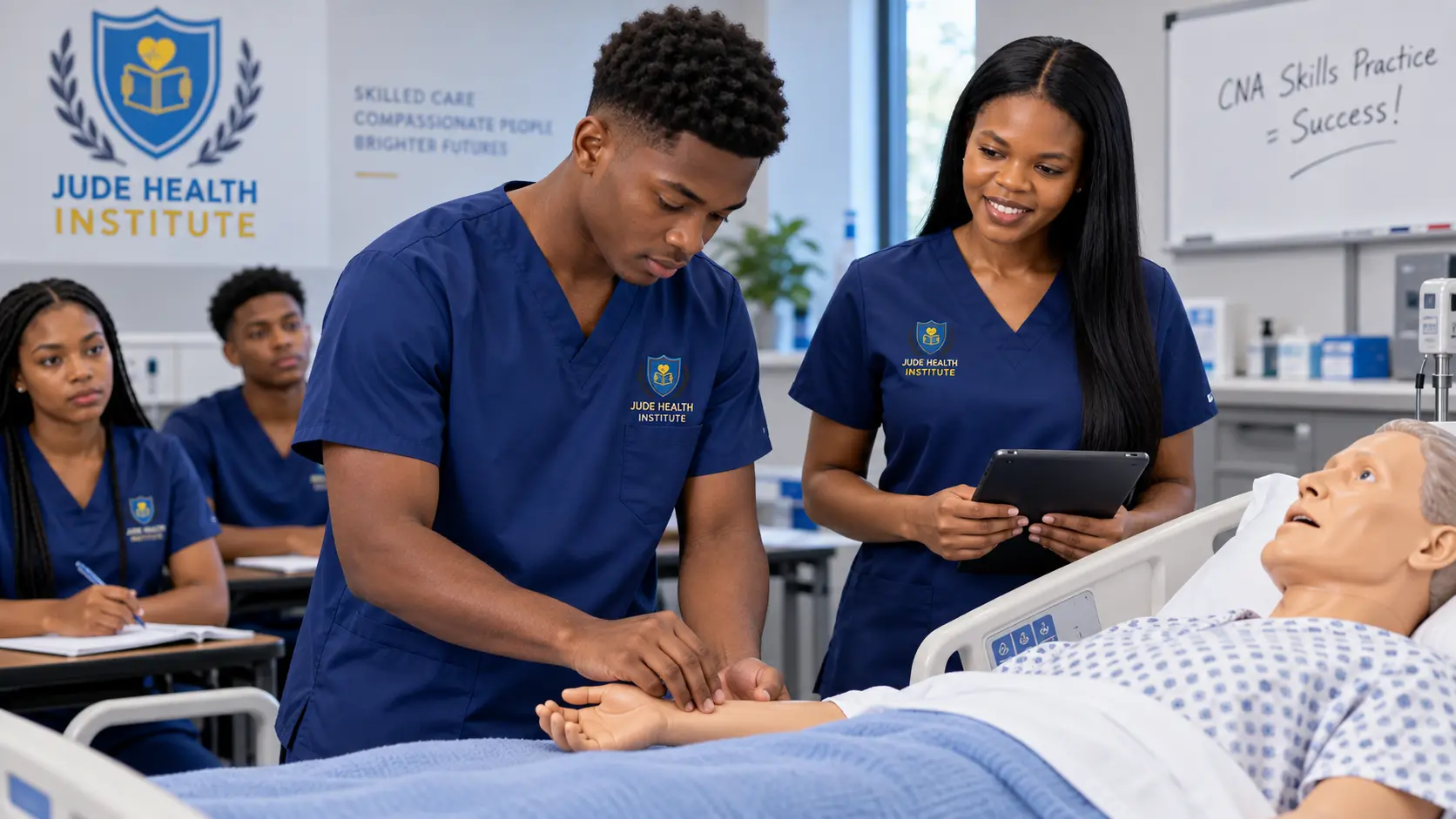
Illustration: A student in navy scrubs takes a pulse on a manikin in a hospital bed while an instructor with a tablet watches

Illustration of what this course covers, not a photograph of our centre. Visit us on Lake Ellenor Drive, Orlando, to see the real classroom.

Overview

About this course

This program is built for people who need to pass the state examination, not for people starting from zero. Instruction is led by experienced healthcare professionals in small groups, and combines written-examination review with supervised practice of the clinical skills the evaluation actually tests.

Courses are taught in English, with bilingual assistance in Haitian Creole and Spanish where available.

Curriculum

What you will learn

The concrete skills covered, so you can compare this against any other course you are considering.

  • Handwashing to checkpoint standard, and why it is scored although it is never prompted
  • Indirect care — rights and preferences, communication, privacy, call-light placement, comfort, safety and infection control — threaded through every skill
  • Measuring and recording a radial pulse and respirations accurately, to time
  • Emptying a urinary drainage bag and recording output on an intake and output form
  • Perineal care and indwelling catheter care
  • Mouth care for a resident with teeth, and for one with dentures
  • Partial bed bath and back rub, foot care, and hand and nail care
  • Side-lying positioning, and changing bed linen with the resident in bed
  • Passive range-of-motion exercises for the shoulder, elbow, wrist, hip, knee and ankle
  • Ambulation and bed-to-wheelchair pivot transfers using a gait belt
  • Bedpan assistance, dressing a resident with a weak arm, and feeding a seated resident
  • Test-day mechanics: identification rules, timing, mid-skill corrections and the resident-actor role

Who it is for

Is this the right course for you?

If more than one of these describes you, it probably is. If the other side describes you better, call us and we will point you elsewhere.

This is probably right for you if

  • Individuals preparing to challenge the Florida CNA examination
  • Students who need additional clinical-skills practice
  • Candidates who previously attempted the CNA examination
  • Healthcare workers returning to the field
  • English-language learners who need additional support

Another course would serve you better if

  • Your route to the exam requires a state-approved training programme of at least 120 hours.
  • You want a guaranteed pass, certification or job. No lawful provider can offer one.
  • You need supervised clinical hours in a licensed nursing home.
  • You have unresolved criminal history that may affect eligibility. Address background screening first.
  • You are not comfortable with intimate personal care, bodily fluids or helping to move people.
  • You want to give medication or assess patients. Both sit outside the CNA scope.

Real Google reviews

What our students say

Unedited words from students at the Orlando centre. Nothing here is written by us.

4.950 Google reviews

  • Rose F.

    Google review

    “Great training, I learned so much. … All the instructors are nurses with experience.”
  • Maita C.

    Google review

    “Good school with great instructors. … I recommend anyone who’s interested in becoming a CNA or who just needs a review to go there without hesitation.”
  • France B.

    Google review

    “I love the school, excellent teachers. Bilingual class is very good. I felt comfortable during the whole session. Thank you”
  • Abria A.

    Google review

    “The best school, Ms. Jude is patient and takes her time to make sure everyone understands. 10/10 recommend”
  • Ralph A.

    Google review

    “I feel proud that I chose to come to Jude Health Institute. The professors do their classes well. The students understand the lessons. We are pleased to be part of your class”
  • Dina S.

    Google review

    “I love love the CNA prep course. Love the teachers. I talk about the program wherever I go. … I didn’t regret going.”
  • Marie D.

    Google review

    “I have no words! We learned so much. … They offer class in English, Creole and Spanish.”
  • Evelyne F.

    Google review

    “I would recommend this healthcare training to anyone who is looking for a great healthcare career path. I did not regret coming”
  • Rabel B.

    Google review

    “Good school great teacher. Ms. Judy is the best. … I learned so much”
  • Michaelle B.

    Google review

    “I love the school, I love my Teacher Judy, she makes it easy to learn.”

Read all 50 reviews on Google · or call (407) 606-7964 to speak with an advisor.

The job

What CNA work actually involves

CNA work is hands-on care at the bedside — in long-term care, on hospital units, in rehabilitation and in private homes. Shifts revolve around activities of daily living: washing, dressing, toileting, moving residents safely from bed to chair, eating and drinking. CNAs also record pulse, respirations and fluid intake and output, answer call lights, and reposition residents to protect their skin.

The less visible half is observation and reporting. A CNA spends more time with a resident than anyone else, so they are often the first to notice the new bruise, the refused meal or the sudden confusion — and to report it to the nurse. CNAs work within a delegated scope under a licensed nurse and follow the care plan. Treatment decisions and independent clinical judgement sit outside that scope.

The work is physically and emotionally demanding: long hours on your feet, safe lifting and transferring, bodily fluids, and residents who may be confused, in pain or resistant to help.

Know the difference

Examination preparation is not a training programme

Examination preparation is narrower than training. It means structured rehearsal for two assessments — a knowledge test and a timed skills demonstration scored against published checkpoints — aimed at the content outline, the sequencing evaluators look for, timing, and the rules on the day. What it is not is a state-approved training programme under Rule 64B9-15.006 of the Florida Administrative Code.

Preparation-only study has a place in Florida because section 464.203 of the Florida Statutes sets out more than one route to the examination, including some that do not require an approved programme first. No preparation can promise a result: Prometric’s evaluators score independently, against fixed checkpoints.

The exam

What the examination actually tests

The examination has two parts. The written, or knowledge, test is multiple choice and taken on computer; section 464.203 also allows an oral examination in its place on request. The clinical skills test is a timed practical demonstration, observed by two nurses and scored against published checkpoints. The standard is demonstrated competency, not perfection.

Skills are assigned by computer when you are scheduled — not chosen by you, and not by the evaluator on the day. Three are prompted. The other two, handwashing and indirect care, are never prompted but are always scored. Indirect care runs through every assigned skill, and it is a common source of lost checkpoints.

  • Two parts: a written test and a skills demonstration
  • An oral exam can replace the written test on request
  • Skills are assigned by computer, not chosen
  • Handwashing and indirect care are always scored

Certification

How Florida CNA certification works

Certification is granted by the Florida Department of Health through the Board of Nursing, which contracts with Prometric to administer the examination.

Under section 464.203, the Department certifies applicants who pass the competency examination and either hold a high school diploma or its equivalent or are at least 18. Prometric’s bulletin lists five routes: completed an approved programme, currently enrolled in one, challenger, other nursing training, and lapsed nursing assistant. Every applicant must also pass Level II background screening.

The steps are yours to take, and the timelines belong to the Board and to Prometric. We can explain the process. We cannot influence eligibility, scheduling or scoring.

  • Certified by the Florida Department of Health
  • Five routes to the exam, set out by Prometric
  • Level II background screening for every applicant
  • We cannot influence eligibility, scheduling or scoring

Career outlook

Where CNAs work, and what it pays

CNAs work in skilled nursing and long-term care, assisted living, hospitals, rehabilitation and post-acute units, home health, hospice and adult day programmes. Long-term care is the largest setting, and it is well represented across Orlando and Central Florida. Under section 400.211 of the Florida Statutes, a person must be certified to work as a nursing assistant in a Florida nursing home unless licensed as a nurse, subject to a limited grace period.

The three figures here are national, from the US Bureau of Labor Statistics. Pay varies by employer, setting, shift and locality. A national median is not a local or a starting figure, and no provider can promise a wage or a position.

Many people treat the credential as an entry point. It is a common prerequisite or advantage for practical nursing and associate degree programmes, and bedside experience feeds the assessment skills those programmes build on. Florida also defines a step up: under section 400.211, a CNA with clear and active certification for a minimum period who completes an additional Board-approved medication administration course may be designated a qualified medication aide, working under nurse supervision. Rule 64B9-15.011 requires at least 24 hours of in-service training every two years.

Before you start

Requirements and what to bring

What the state sets, and what is simply practical. Anything set by the state should be confirmed against the source, because it changes.

Set by the state or the test administrator

  • Meet a route under section 464.203 of the Florida Statutes: a high school diploma or equivalent, being at least 18, or an approved training programme.
  • Pass Level II background screening by Livescan through an FDLE-approved vendor. Paper fingerprint cards are not accepted.
  • Be deemed eligible to test by the Department of Health before you schedule.
  • Bring your Prometric Admission to Test letter.
  • Bring two forms of identification: one current and government-issued, with a photo and signature and a name matching your application; the second must also carry your signature.
  • Wear flat, non-skid, closed-toe shoes for the clinical skills test.
  • No phones, electronics, study materials or bags in the testing area, and no guests.
  • Request any accommodation, or extra time as a non-native English speaker, in advance and with documentation.

Practical

  • A watch with a second hand. The pulse and respiration skills need it.
  • Scrubs or a uniform, hair tied back, short nails, and no jewellery that gets in the way of gloving.
  • Arrive at least 30 minutes early, ready to act as the resident for another candidate.
  • Check Prometric’s current skills checklist, content outline and fees when you apply.

Read this

What we are and are not

Published in full rather than buried in a footer. If another provider will not tell you where its limits are, that is worth noticing.

Common questions

Frequently asked questions

Straight answers to what students ask us most, including the ones other providers avoid.

Not answered here? Ask us directly. If we hear a question more than once it ends up on this page.

(407) 606-7964
Do I have to complete a training programme before testing in Florida?

Not under every route. Section 464.203 of the Florida Statutes sets out more than one path to the examination, and Prometric’s bulletin describes five routes, including a challenger route for candidates with no prior training. Confirm which applies to you with the Board of Nursing.

What is on the written test?

It covers five areas of Prometric’s content outline: the role of the nurse aide, promotion of safety, promotion of residents’ function and health, basic nursing care, and specialised care for residents with changes in health.

What exactly is indirect care?

Prometric defines it as care related to residents’ rights and preferences, communication with the resident, resident safety, comfort and needs, and infection control. It is not a separate station. It is scored from how you behave throughout the assigned skills — knocking, explaining, privacy, comfort checks.

Can I correct a mistake during the skills test?

Yes, within limits. You may correct yourself while performing a skill, but you must tell the nurse and actually perform the correction. Once you have said a skill is complete you cannot go back to it, and no correction is allowed after a safety issue.

What happens if I fail?

You receive a score report at the test site that day, and results go to the Board of Nursing. Retaking requires a new application and fees. Failing three attempts ends eligibility for re-examination unless you complete an approved training programme — Prometric states at least 120 hours.

How long does it take to get my certificate?

Prometric indicates roughly one week for scores to reach the Board of Nursing, and up to about four weeks for the Board to issue and mail a certificate. Score reports appear online within 48 hours. These timelines belong to the Board and Prometric, not to us.

Are there language accommodations?

The written test can be taken in an audio format, requested on your application rather than on test day. Section 464.203 also provides an oral examination in place of the written portion on request. Extra time and disability accommodations need advance documentation. Our own teaching includes bilingual assistance in Haitian Creole and Spanish where available.

No obligation · Speak with an advisor

Ask us anything about CNA Exam Preparation

Tell us where you are in your career and an advisor will come back with confirmed dates, the full cost and what to bring.

Call (407) 606-7964

9:00am – 5:00pm, Monday to Friday

Request the next start date

Two quick steps — tell us what you need, then how to reach you.

What are you looking for?
How should we reach you?

By sending this enquiry you agree to our Terms and Privacy Policy.

We reply during office hours, 9:00am – 5:00pm, Monday to Friday.