Jude Health Institute

Healthcare Exam Preparation

Healthcare Examination Preparation

Structured review, practice questions and test-taking strategy for the TEAS, HESI, NCLEX and CNA examinations.

4.9 · 50 Google reviews
  • DeliveryVirtual and in person
  • LanguagesEnglish, Haitian Creole, Spanish
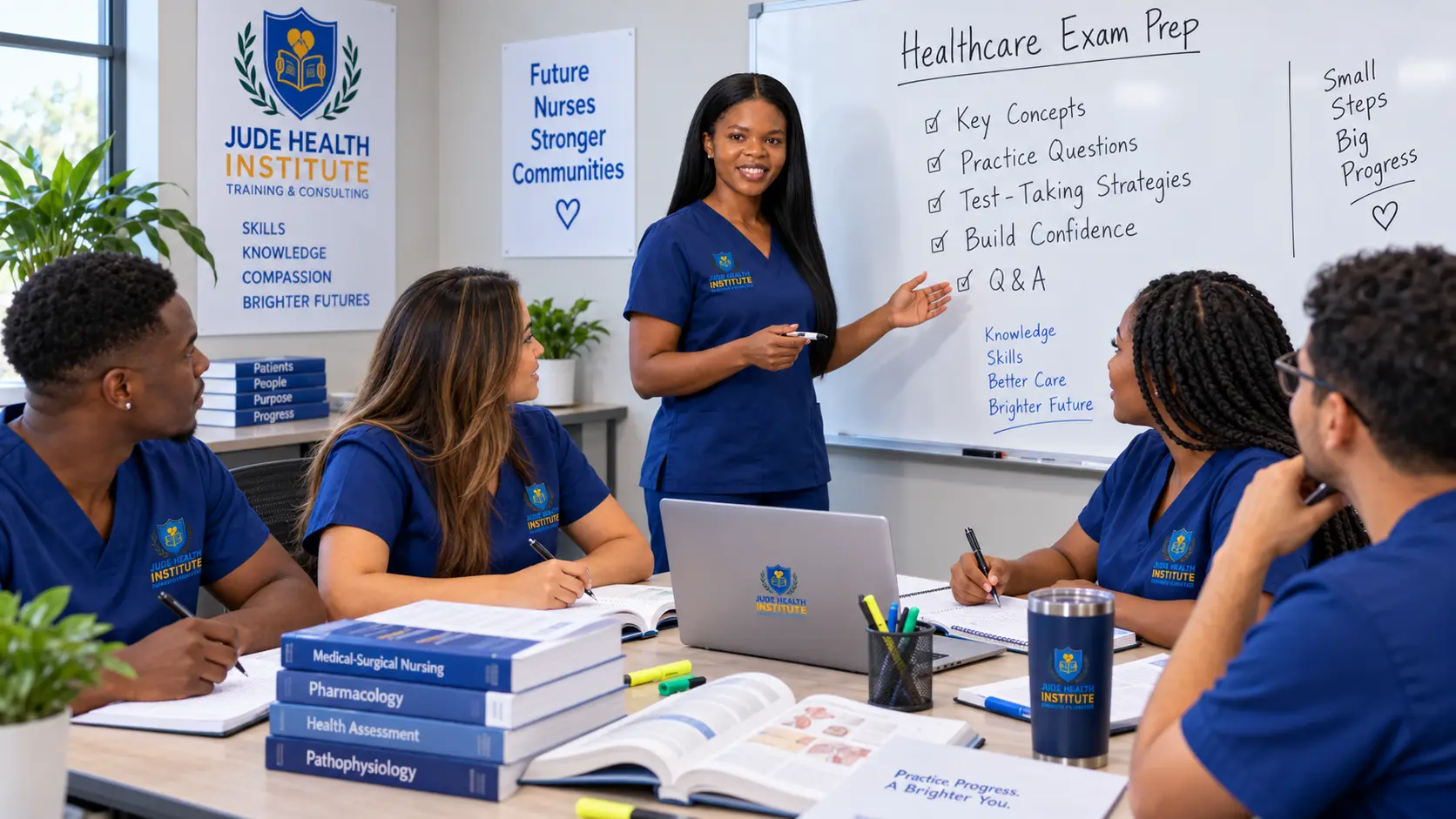
Illustration: An instructor leads a small exam-preparation group from a whiteboard

Illustration of what this course covers, not a photograph of our centre. Visit us on Lake Ellenor Drive, Orlando, to see the real classroom.

Overview

About this course

Healthcare Examination Preparation is a set of separate review courses, one for each exam, for people who already have a test in front of them. That might be an entrance exam for a nursing or allied health programme, the NCLEX, the Florida CNA exam or a national phlebotomy exam. Each review works from the exam owner’s own published outline, so your time goes on what the test actually measures.

It is built for the stage just before an exam, when the content is familiar but the format, the pacing and the kind of reasoning the questions demand are not.

The limits matter as much as the content. A review course prepares you. It does not make you eligible to sit an exam, and it does not award anything: licences and certificates come from outside bodies. No provider can promise a pass, and we do not claim a pass rate.

Curriculum

What you will learn

The concrete skills covered, so you can compare this against any other course you are considering.

  • How your exam is built, timed and scored, from the exam owner’s own published outline
  • TEAS and HESI A2: practice in the academic areas your programme tests, with worked explanations
  • NCLEX: working a case study through each clinical judgement step in turn
  • NCLEX: prioritisation, delegation and safety questions across the test plan’s eight Client Needs areas
  • NCLEX: the item formats you will meet, rehearsed until they feel familiar
  • CNA written test: the five content areas in Prometric’s Florida outline
  • CNA skills test: how two nurse evaluators score three assigned skills, plus handwashing and indirect care every time
  • Phlebotomy: the content areas your certifying body publishes, from blood collection to safety
  • Dosage calculation: oral, liquid, weight-based and intravenous flow-rate problems
  • Pacing for fixed-length exams, and for the NCLEX’s variable length
  • Reading a question for what it actually asks, and ruling out options systematically
  • Using practice-test results to decide what to study next, instead of rereading everything

Who it is for

Is this the right course for you?

If more than one of these describes you, it probably is. If the other side describes you better, call us and we will point you elsewhere.

This is probably right for you if

  • You have a specific exam ahead: an entrance exam, the NCLEX, the Florida CNA exam or a phlebotomy certification.
  • You keep running out of time, or second-guessing answers you knew.
  • You sat the exam before, did not pass, and want to work on what went wrong.
  • Medication maths is your weak point and you want one-to-one help with it.
  • You have been out of study for a while and need to rebuild exam habits.

Another course would serve you better if

  • You need Board-approved NCLEX remediation or a state-approved CNA training programme. This is neither.
  • You have not studied the subject yet. A review assumes you have covered the material once.
  • You want a guaranteed pass. No honest provider offers one.
  • Your exam is days away and you have not started. Spaced practice needs time.

Real Google reviews

What our students say

Unedited words from students at the Orlando centre. Nothing here is written by us.

4.950 Google reviews

  • Rose F.

    Google review

    “Great training, I learned so much. … All the instructors are nurses with experience.”
  • Maita C.

    Google review

    “Good school with great instructors. … I recommend anyone who’s interested in becoming a CNA or who just needs a review to go there without hesitation.”
  • France B.

    Google review

    “I love the school, excellent teachers. Bilingual class is very good. I felt comfortable during the whole session. Thank you”
  • Abria A.

    Google review

    “The best school, Ms. Jude is patient and takes her time to make sure everyone understands. 10/10 recommend”
  • Ralph A.

    Google review

    “I feel proud that I chose to come to Jude Health Institute. The professors do their classes well. The students understand the lessons. We are pleased to be part of your class”
  • Dina S.

    Google review

    “I love love the CNA prep course. Love the teachers. I talk about the program wherever I go. … I didn’t regret going.”
  • Marie D.

    Google review

    “I have no words! We learned so much. … They offer class in English, Creole and Spanish.”
  • Evelyne F.

    Google review

    “I would recommend this healthcare training to anyone who is looking for a great healthcare career path. I did not regret coming”
  • Rabel B.

    Google review

    “Good school great teacher. Ms. Judy is the best. … I learned so much”
  • Michaelle B.

    Google review

    “I love the school, I love my Teacher Judy, she makes it easy to learn.”

Read all 50 reviews on Google · or call (407) 606-7964 to speak with an advisor.

The exams

Which exam is which

The exams on this page do three different jobs. Entrance exams help a programme decide whether to admit you. Licensure exams feed a Board of Nursing’s decision to license you. Certification exams decide whether an independent body certifies you. Each has a different owner setting the rules.

Entrance exam scores are judged by the school, not the test maker. ATI says it plainly for the TEAS: there is no universal passing score, and each school sets its own minimum.

  • Entrance exams: the school decides what score it needs
  • Licensure exams feed the Board of Nursing’s decision
  • Certification exams: an independent body decides
  • Every exam has its own owner setting the rules

The NCLEX

How the NCLEX works now

The Next Generation NCLEX launched on 1 April 2023, built to better measure clinical judgement and decision-making. The NCLEX-RN and NCLEX-PN now follow test plans that took effect in April 2026. The three figures here come from those plans. The clock keeps running through the introductory screen and every break.

Each case study follows one client through six linked items that mirror NCSBN’s Clinical Judgment Measurement Model: recognise cues, analyse cues, prioritise hypotheses, generate solutions, take action and evaluate outcomes. Other items stand alone. Where an item has more than one correct answer, partial credit is possible. Fifteen items on every exam are unscored pretest questions, and you cannot tell which ones they are.

The exam is adaptive. After each answer the computer re-estimates your ability and chooses the next item to match. Most exams stop once it is 95 per cent certain you are clearly above or clearly below the passing standard. If you sit close to the line, it runs to the maximum. If time runs out first, it scores the items you answered, provided you reached the minimum.

Passing means your final ability estimate is at or above the standard. There is no fixed percentage of candidates who pass, and the length of your exam tells you nothing about your result.

Remediation

Board remediation is a different course

Florida law draws a hard line here. Under section 464.008(3) of the Florida Statutes, an applicant who fails the NCLEX three consecutive times, in any jurisdiction, must complete a Board-approved remedial course before the Board will approve them to sit it again. After remediation they may retake the exam up to three more times before remediation is required again, and they must apply for re-examination within six months of finishing it.

Board of Nursing rule 64B9-3.0025 sets what an approved remedial course must include: at least 80 hours of didactic education and 96 hours of clinical experience, with the non-simulated clinical hours completed in Florida. The Board publishes the list of approved providers, with separate RN and LPN sections.

This review course is not that course, and no hours spent with us count towards it. Exam preparation is a choice. Remediation is a legal condition of re-examination, and only an approved provider can meet it.

The CNA route works the same way. Section 464.203 says an applicant who fails the nursing assistant competency examination in three attempts cannot retest until they complete an approved training programme. Our CNA reviews are not approved training programmes.

Study method

What effective preparation looks like

The research on how people learn is clearer than most study advice. A 2013 review in Psychological Science in the Public Interest compared ten common techniques. Two came out as high utility: practice testing, and distributed practice, meaning study spread out over time. Underlining, rereading and mnemonic devices were of surprisingly low utility.

Treat each wrong answer as information. Most of the value of a practice question is in the explanation: why the right answer is right, and why each wrong option is wrong.

Use the exam owners’ material alongside ours. NCSBN publishes a candidate tutorial and sample case studies. Prometric offers an online practice exam for the Florida written test, and clinical skills readiness tests.

  • Practice testing and spaced study work best
  • Rereading and highlighting do surprisingly little
  • Each wrong answer shows you what to study next
  • Use the exam owner’s own practice material too

Medication maths

Dosage calculation

Medication maths turns up on more than one exam. NCSBN’s 2026 test plans list performing the calculations needed for medication administration for both RN and PN candidates, and the PN plan adds calculating and monitoring intravenous flow rates. The NCLEX puts a calculator on screen. So does the TEAS, which does not allow personal calculators at all.

The calculator is rarely where people go wrong. The errors come earlier: converting units, placing the decimal point, and not noticing that an answer is implausible. The FDA shows why precision matters. A dose written as “5.0 mg” can be misread as 50 mg, and “.5 mg” without its leading zero can be read as 5 mg. Either is a tenfold overdose.

Good preparation means choosing one set-up method and using it every time, estimating before you calculate, and checking each answer against common sense. Private tutoring suits people who need this one skill rebuilt, whatever the exam.

Getting registered

Eligibility and registration sit with the exam owners

Every exam on this page has its own gatekeeper. Each route runs through its own organisation, with its own application, fee and deadline, none of which we control. The Florida NCLEX route, set out here, has the most moving parts.

Florida also offers Graduate Nurse status, which lets a new graduate practise under the direct supervision of a registered nurse before passing. You must apply within three months of graduating, and the status ends if your first attempt is unsuccessful. That is one more reason to prepare properly for the first sitting.

For the Florida CNA exam, you apply to Prometric, and the Department of Health deems you eligible after an FBI fingerprint background check. For the TEAS, ATI offers online proctoring as well as testing at your institution or a PSI test centre. For the HESI A2 or a phlebotomy exam, ask the programme or certifying body how to book.

  • Each exam has its own application, fee and deadline
  • Graduate Nurse status ends if your first attempt fails
  • CNA: you apply to Prometric, then are deemed eligible
  • The TEAS can be taken online or at a test centre

Full price list

Every course and what it costs

Published in full. You should not have to hand over a phone number to find out the price of a course.

Available courses
CoursePrice
TEAS Preparation Course$299
HESI Preparation Course$299
NCLEX-PN Review$499
NCLEX-RN Review$599
CNA Written Exam Review$99
CNA Clinical Skills Review$199
Phlebotomy National Exam Review$149
Private Dosage-Calculation Tutoring$75 per hour
Three Private Tutoring Sessions$199

Before you start

Requirements and what to bring

What the state sets, and what is simply practical. Anything set by the state should be confirmed against the source, because it changes.

Set by the exam owners

  • NCLEX: graduation from a nursing education programme the Florida Board of Nursing accepts. Its licensure application lists the qualifying routes.
  • NCLEX: every Florida applicant submits fingerprints electronically through a Livescan provider for background screening.
  • Florida CNA: one of the five eligibility routes in Prometric’s bulletin, from completing a state-approved training programme to challenging the exam without training. An application and its fees are valid for one year.
  • TEAS: retake rules are set by the programme you apply to. ATI itself sets no waiting period between attempts.
  • Phlebotomy: eligibility is set by the certifying body. NCCT, for example, asks for documented venipunctures and capillary punctures on several of its routes.

Practical

  • For virtual sessions: a computer or tablet, a reliable connection and a quiet space.
  • Any previous score report from the exam owner, if you have sat the exam before.
  • Ask us before you pay which language support is available for your exam and delivery mode.

Read this

What we are and are not

Published in full rather than buried in a footer. If another provider will not tell you where its limits are, that is worth noticing.

Common questions

Frequently asked questions

Straight answers to what students ask us most, including the ones other providers avoid.

Not answered here? Ask us directly. If we hear a question more than once it ends up on this page.

(407) 606-7964
Who awards the licence or certificate?

Never us. A Florida nursing licence comes from the Florida Board of Nursing once you pass the NCLEX and meet its other requirements. The CNA certificate also comes from the Board, after you pass the Prometric exam. Phlebotomy certification comes from the certifying body whose exam you pass.

Is there a Florida version of the NCLEX?

No. The NCLEX is a national exam developed by NCSBN, and the same test plans apply everywhere. What Florida controls is who is eligible to sit it, who is licensed afterwards, and the remediation rule for repeat candidates.

I have failed the NCLEX three times. Can I take your review instead of remediation?

No. In Florida, three consecutive failures in any jurisdiction mean you must complete a Board-approved remedial course before the Board will approve you to retest. Our review does not meet that requirement. Choose a provider from the Board’s approved list first.

I failed the NCLEX once or twice. Will a review help?

It can, if it targets what went wrong. The Board sends failing candidates a Candidate Performance Report showing relative strengths and weaknesses against the test plan. Florida will not let you schedule a retake until 45 days after your last attempt, so use that gap to study rather than just wait.

Can you guarantee that I will pass?

No, and nobody honestly can. The result is decided by the exam owner’s scoring, not by the provider who prepared you. What we can do is show you where you stand now and what to work on next.

Is the Florida CNA exam available in Spanish or Haitian Creole?

Prometric offers the written test in English and Spanish, with an audio version you request on your application; Florida law also allows an oral exam in its place on request. The clinical skills test is in English only, and Haitian Creole is not listed as a test language. Our bilingual support, when available, helps you learn the material but cannot change the language you test in.

Are exam fees included in your prices?

Assume not, unless we confirm in writing that a fee is included. Exam fees are paid to the exam owner. For reference, Pearson VUE’s NCLEX registration fee for US licensure is $200, and Prometric charges $155 for both parts of the Florida CNA exam. Fees change, so check the owner’s current figure before you budget.

Do I need the TEAS or the HESI A2?

Whichever your programme asks for. The choice is the school’s, and so is the minimum score. Tell us what yours requires and we will point you to the right review.

How do the CNA reviews here differ from your CNA Exam Preparation course?

They are separate products. Each review here focuses on one part of the exam, either the written test or the clinical skills test. The CNA Exam Preparation course has its own page and prepares you for both. Ask us which fits where you are.

How long before my exam should I start?

There is no single right answer, and we will not invent one. For the NCLEX, the Authorization to Test lasts about 90 days on average, so start preparing before it arrives rather than after.

Where this comes from

Sources

Every regulatory statement on this page traces to a primary source. We would rather you checked them than took our word for it — and requirements change, so confirm your own before you rely on anything here.

  1. NCSBNNext Generation NCLEX: purpose and April 2023 launch (opens in a new tab)
  2. NCSBNNCLEX-RN Test Plan, effective April 2026 (opens in a new tab)
  3. NCSBNNCLEX-PN Test Plan, effective April 2026 (opens in a new tab)
  4. NCSBN2026 NCLEX Candidate Bulletin: registration, fees, results and retakes (opens in a new tab)
  5. Florida Statutes s. 464.008licensure by examination and remedial courses (opens in a new tab)
  6. Florida Administrative Code r. 64B9-3.0025requirements for approved remedial courses (opens in a new tab)
  7. Florida Board of Nursingapproved remedial course providers, RN and LPN (opens in a new tab)
  8. Florida Board of Nursinglicensure by examination application (DH-MQA 1094) (opens in a new tab)
  9. Florida Board of Nursingre-examination application (DH-MQA 1120) (opens in a new tab)
  10. Florida Statutes s. 464.203CNA certification and the three-attempt rule (opens in a new tab)
  11. PrometricFlorida CNA Candidate Information Bulletin (opens in a new tab)
  12. ATITEAS Version 7 exam details and proctoring options (opens in a new tab)
  13. ATITEAS FAQs: passing scores, retakes and calculator (opens in a new tab)
  14. ElsevierHESI Admission Assessment Exam Review, 6th edition (opens in a new tab)
  15. American Medical TechnologistsRPT competencies and examination specifications (opens in a new tab)
  16. NCCTPhlebotomy Technician (NCPT) certification and eligibility (opens in a new tab)
  17. Association for Psychological ScienceDunlosky et al. (2013), effective learning techniques (opens in a new tab)
  18. US Food and Drug Administrationpreventing tenfold dose errors from trailing and leading zeros (opens in a new tab)

No obligation · Speak with an advisor

Ask us anything about Exam Preparation

Tell us where you are in your career and an advisor will come back with confirmed dates, the full cost and what to bring.

Call (407) 606-7964

9:00am – 5:00pm, Monday to Friday

Request the next start date

Two quick steps — tell us what you need, then how to reach you.

What are you looking for?
How should we reach you?

By sending this enquiry you agree to our Terms and Privacy Policy.

We reply during office hours, 9:00am – 5:00pm, Monday to Friday.