 CNA
CNA11 min read
Florida CNA Exam Day Checklist: What to Bring, What Happens in Order, and What to Do If Something Goes Wrong
The week before, what to bring, each stage at the test site in order, and what to do if your exam day goes wrong.
The daily work, Florida credentials, May 2025 pay, physical demands and next steps for each role, set side by side, with a checklist to help you choose.
By the Jude Health Institute teamSeptember 18, 202612 min read
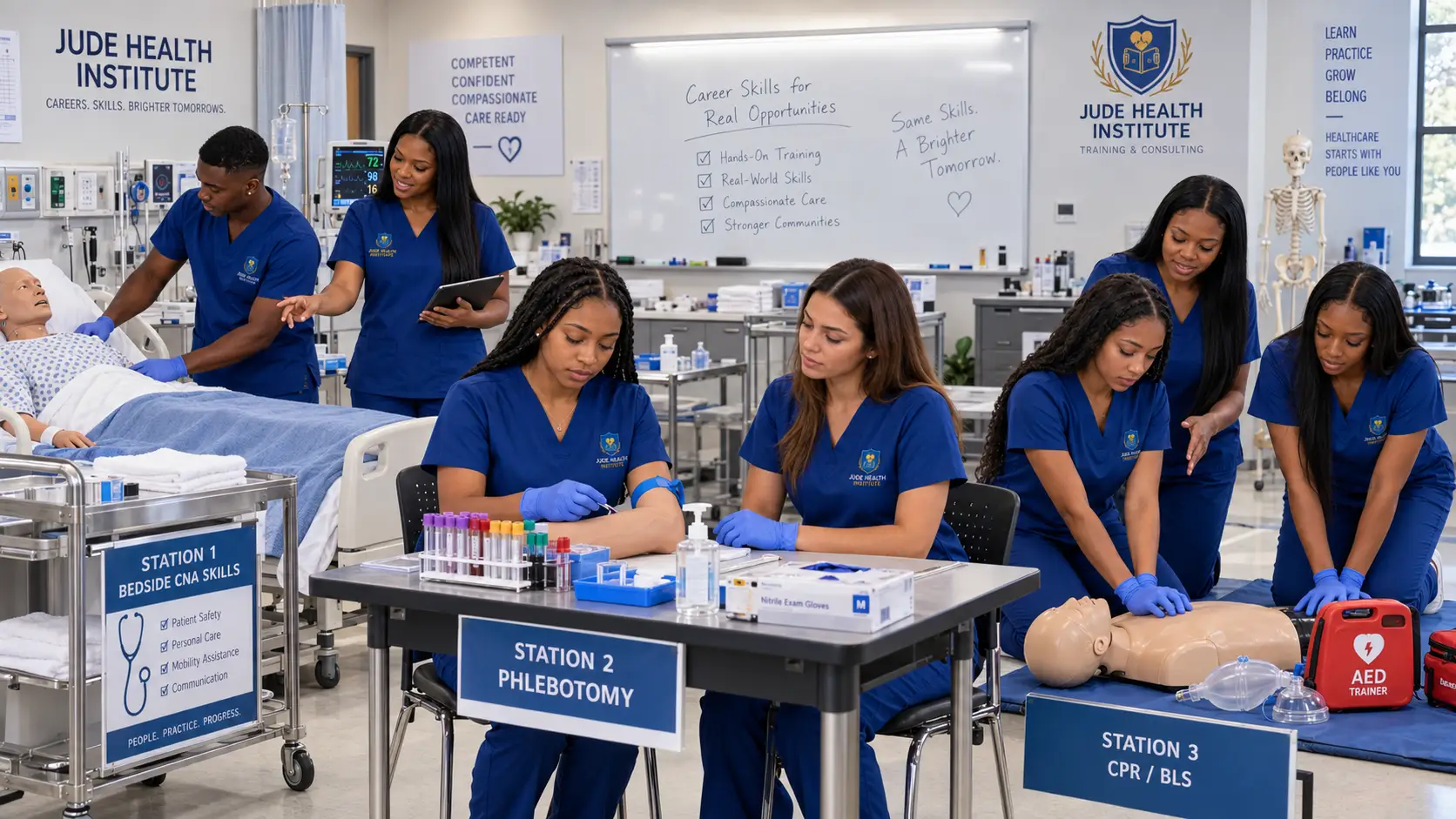
CNA and phlebotomy are the two first healthcare roles people in Orlando most often weigh against each other. Both are shorter routes into patient care than nursing school, but they mean different working days, credentials and next steps. This guide sets them side by side, using Florida law and the latest federal pay data, so you can choose the one that fits you.
The simplest way to compare these jobs is by how long you spend with each person. A certified nursing assistant, or CNA, looks after the same small group of patients or residents for a whole shift, often for weeks or months. A phlebotomist meets a long line of people, one after another, for a few minutes each.
According to the US Bureau of Labor Statistics (BLS), nursing assistants (opens in a new tab) bathe patients, help them use the toilet and dress, turn them and move them between beds and wheelchairs, serve meals and help them eat, and measure vital signs such as blood pressure and temperature. They also listen to patients’ concerns and pass them on to the nurse. In practice, you are often the first person to notice that something has changed.
Phlebotomists (opens in a new tab) draw blood for tests, transfusions, research and donations. The BLS lists their duties as verifying each patient’s identity, drawing the blood, labelling it for testing and keeping equipment clean. It also notes that they explain their work to relax nervous patients. The needle is only part of it, and a single labelling mistake can attach a result to the wrong patient.
So one job is broad, continuous and personal. The other is narrow, repeated and precise. Neither is easier. They ask different things of you.
The table puts the main differences in one place. Pay figures are BLS medians for May 2025 and growth figures are its 2025–35 projections. They describe occupations, not what any one person will earn.
| CNA | Phlebotomist | |
|---|---|---|
| Core work | Personal care, mobility, meals and vital signs for the same patients all shift | Drawing and labelling blood samples from many patients, a few minutes each |
| Florida credential | State certificate and a listing on the CNA Registry | No state licence; a national certification, which some employers prefer |
| Who awards it | Florida Board of Nursing, after the Prometric exam | A national body such as NHA, ASCP, AMT or NCCT, after its own exam |
| Typical preparation | A Board-approved programme of at least 120 hours, or the challenger route | A programme usually under a year, plus 30 to 100 documented live draws, depending on the body |
| Largest US employers | Nursing care facilities (36%) and hospitals (32%) | Hospitals (36%) and medical and diagnostic laboratories (33%) |
| US median pay, May 2025 | $42,260 | $45,230 |
| Orlando area median pay, May 2025 | $37,690 | $39,390 |
| Orlando area jobs, May 2025 | About 12,000 | About 1,040 |
| Projected US growth, 2025–35 | 3% (with orderlies) | 7% |
Nationally, the BLS says 36 per cent of nursing assistants work in nursing care facilities, 32 per cent in hospitals and 11 per cent in continuing care and assisted living communities. In Florida, section 400.211 of the Florida Statutes requires nursing assistants in nursing homes to be certified, with narrow exceptions such as licensed nurses.
Phlebotomists are spread differently. The BLS puts 36 per cent in hospitals, 33 per cent in medical and diagnostic laboratories, 16 per cent in other ambulatory healthcare services and 9 per cent in physician offices. Around Orlando, that means hospital units, laboratory collection sites, clinics and blood donation services.
The biggest local difference is volume. In the BLS May 2025 survey for the Orlando-Kissimmee-Sanford metro area, there were about 12,000 nursing assistant jobs and about 1,040 phlebotomist jobs. That is more than eleven CNA posts for every phlebotomy post. That matters if you want the widest choice of employers and shifts.
CNA certification is a state credential. Under section 464.203 of the Florida Statutes, the Board of Nursing issues the certificate to people who pass the competency exam and the required background screening. The exam has a written part and a skills demonstration, and you can ask for an oral exam in place of the written part. Prometric runs it for the Florida Department of Health, and once you pass, the Board sends your certificate and adds you to the CNA Registry.
There is more than one route to the exam. Prometric’s Florida bulletin (opens in a new tab) (revised 1 November 2025) describes five, including a challenger route for people with no nursing assistant training. Every applicant needs Level II background screening by Livescan fingerprinting. If you fail three times, you must complete a state-approved programme of at least 120 hours before you can test again. For what the two parts cover, read what the Florida CNA exam tests.
Phlebotomy works differently, because Florida does not license phlebotomists. Section 483.803 of the Florida Statutes (opens in a new tab) defines the clinical laboratory personnel the state regulates, then says the term does not include phlebotomists. What you can earn is a national certification from an independent body. The BLS notes that some employers prefer certified phlebotomists, so read the job postings you want before you pick one.
Each certifying body sets its own eligibility, including how many documented live draws you need. Check its current rules before you commit to training:
For the CNA, time depends on your route. Under Rule 64B9-15.006 of the Florida Administrative Code, a Board-approved programme needs at least 80 classroom hours and 40 clinical hours, 20 of them in a licensed nursing home. The challenger route has no required training, but all the preparation falls to you. Either way, you then apply, complete fingerprinting and wait to be cleared to test.
After you pass, Prometric says scores take about a week to reach the Board, and the Board can take four weeks to issue and mail the certificate. Its bulletin lists $155 for both exam parts, plus a separate fee collected by the fingerprinting vendor.
For phlebotomy, the BLS says programmes usually take less than a year. The bottleneck can be supervised live draws rather than classroom time, because most certifying bodies want a documented count before you sit their exam. Certification fees vary by body: in September 2026, AMT listed $125 and NCCT $119.
Training fees vary widely, and third-party fees are usually extra, so ask any provider for an itemised list. If you are leaning towards the CNA exam, CNA exam preparation is structured practice for both parts. It is exam preparation, not a Board-approved training programme, so confirm your route first.
Nationally, phlebotomists earn a little more. In May 2025 the median annual wage was $45,230 for phlebotomists and $42,260 for nursing assistants, according to the BLS. The middle 80 per cent of phlebotomists earned between $35,780 and $58,780; for nursing assistants the range was $33,940 to $51,980.
Growth favours phlebotomy in percentage terms. The BLS projects phlebotomist employment to grow 7 per cent from 2025 to 2035, much faster than the average, with about 18,000 openings a year. For nursing assistants and orderlies it projects 3 per cent, about as fast as the average, but around 203,300 openings a year, because that occupation is more than ten times larger.
Orlando pays less than the national figure for both. In the BLS May 2025 survey for the Orlando-Kissimmee-Sanford area, the median was $37,690 a year ($18.12 an hour) for nursing assistants and $39,390 ($18.94 an hour) for phlebotomists. That is a gap of 82 cents an hour. Both sit below the area’s median for all occupations, which was $46,630. The Orlando phlebotomy figure comes from a much smaller group, so treat it as approximate.
Setting matters too. Nationally, phlebotomists in outpatient care centres ($48,030) and laboratories ($46,670) had higher medians than those in hospitals ($44,220).
The BLS lists compassion, communication and physical stamina as important in both jobs. It adds patience for nursing assistants, and attention to detail and manual dexterity for phlebotomists. See which of these statements sound like you:
Both are harder on the body than they look. The BLS says nursing assistants and phlebotomists each have one of the highest rates of injuries and illnesses of all occupations. For nursing assistants, much of that comes from moving patients. For phlebotomists, the risk comes from blood, needles and other equipment.
CNA work is physically heavy. You are on your feet, turning and transferring people, and dealing with bodily fluids. The emotional load is steady too. You may care for people who are confused, in pain or near the end of life, and you get to know them well. Some find that deeply rewarding. Others find it hard to leave at the door.
Phlebotomy involves less lifting but is tiring in other ways. You stand for long periods, repeat the same fine movements and meet a lot of anxious people. The pressure comes in short bursts: a full waiting room, a vein you cannot find, a patient who feels faint.
Hours can be demanding in both. Because care runs around the clock, the BLS says nursing assistants may work nights, weekends and holidays. Most phlebotomists work full time, and those in hospitals and laboratories may work the same unsocial hours.
A CNA is a common first step towards nursing. In Florida, one defined next step is qualified medication aide. Under section 400.211, a CNA whose certification has been clear and active for at least a year can complete a 34-hour Board-approved course and, after showing competence, give medication in a nursing home under the direct supervision of a licensed nurse.
Further on is practical nursing. The BLS says licensed practical nurse (LPN) programmes typically take about a year, followed by a licensing exam. The median LPN wage was $64,400 nationally and $61,030 in the Orlando area in May 2025. Bedside time as a CNA gives you a working feel for nursing before you commit to that, or to registered nursing later.
Phlebotomy points towards the laboratory and the clinic. According to the BLS, clinical laboratory technicians usually need an associate degree or a postsecondary certificate, and technologists a bachelor’s degree. Unlike phlebotomists, both count as clinical laboratory personnel under section 483.803. The national median for the group was $62,930 in May 2025.
Phlebotomy also fits inside medical assisting. The BLS notes that some medical assistants draw blood, and it projects 13 per cent growth for the occupation from 2025 to 2035. The median was $45,690 nationally and $43,800 in the Orlando area in May 2025. Each next step has its own admission and licensing rules.
Yes, you can do both. The two credentials come from different organisations, so holding one never blocks the other. Some jobs combine them. The NCCT describes patient care technicians as doing basic nursing assistant tasks, such as vital signs and help with daily living, alongside ECGs and phlebotomy.
Most people still start with one. Choose CNA first if nursing is your goal or you want the largest local job market. Choose phlebotomy first if you are drawn to laboratory or clinic work, or bedside personal care is not for you. If you want both, the career-skills package prepares you for the CNA exam, phlebotomy and CPR together, and the phlebotomy workshop can be taken on its own. Neither awards the CNA certificate or a phlebotomy certification. Before you decide:
Written by our team
Jude Health Institute
Our guides are written by the team at our Orlando centre on Lake Ellenor Drive. Every regulatory statement names its primary source, and requirements change, so confirm your own before you rely on anything here.
Have a question about your situation?
We will talk it through with you, with no pressure and no obligation.
Common questions
Neither is better in general. A CNA gives broad, continuous personal care and is a common route into nursing. A phlebotomist performs one precise procedure many times a day and leans towards laboratory and clinic work. The better choice is the one whose daily work you can picture yourself doing for years.
Slightly, on BLS figures. In May 2025 the national median was $45,230 for phlebotomists and $42,260 for nursing assistants. In the Orlando-Kissimmee-Sanford area the medians were $39,390 and $37,690, a gap of 82 cents an hour. These describe the occupations, not what any individual will earn.
It depends on your route. Florida’s challenger route lets you sit the CNA exam without a training programme, but you still need fingerprinting, clearance and a test date. Phlebotomy certification usually needs a training programme or work experience plus a documented number of live draws, and arranging those draws can be the slowest part.
No. Section 483.803 of the Florida Statutes leaves phlebotomists out of the clinical laboratory personnel the state regulates. Many people still earn a national certification from a body such as NHA, ASCP, AMT or NCCT, because some employers prefer it. Check the postings you want before you choose a body.
Yes, through the challenger route in Prometric’s Florida bulletin, which is for people with no nursing assistant training or experience. You still need to pass background screening and both parts of the exam. If you fail three times, you must complete a state-approved programme of at least 120 hours before you retest.
It depends on the certifying body. NHA asks for at least 30 venipunctures and 10 capillary or finger sticks. AMT asks for at least 50 venipunctures and 10 skin punctures, and some NCCT pathways ask for more. Choose your certifying body before you choose your training.
It is a common one. You learn bedside care, observation and reporting under a nurse’s direction, which gives you a realistic view of nursing before you apply. Nursing programmes set their own admission rules, so check the ones you want.
CNA, by a wide margin. The BLS May 2025 survey counted about 12,000 nursing assistant jobs in the Orlando-Kissimmee-Sanford area and about 1,040 phlebotomist jobs. More jobs means more choice, though it guarantees no one a position.
Yes. They come from different organisations and do not conflict. Patient care technician roles, as the NCCT describes them, combine nursing assistant tasks with phlebotomy and ECGs. You can earn one, start working, and add the other later.
No. The Florida Board of Nursing certifies CNAs after the Prometric exam, and national bodies award phlebotomy certification after their own exams. Jude Health Institute is not accredited or state approved. We provide exam preparation and skills instruction, and no one can guarantee a pass.
Still have a question? Call us at (407) 606-7964.
Keep reading
CNA11 min read
The week before, what to bring, each stage at the test site in order, and what to do if your exam day goes wrong.
 CNA
CNA12 min read
The written test’s five content areas, the 20 skills Prometric can assign, how handwashing and indirect care are scored, and how retakes work.
 Continuing education
11 min read
Who needs CE, which subjects are mandatory and when, how hours reach CE Broker, and what to check before you renew a Florida nursing licence.
No obligation · Speak with an advisor
New sessions are forming. Tell us what you need and an advisor will be in touch with confirmed dates, costs and next steps.
9:00am – 5:00pm, Monday to Friday
Two quick steps — tell us what you need, then how to reach you.
JHI Advisor
Jude Health Institute
Talk to an advisor about courses, schedules, costs and your next step. Pick a day to start.
Free · 30 minutes · No obligation