
 CNA
CNA11 min read
Florida CNA Exam Day Checklist: What to Bring, What Happens in Order, and What to Do If Something Goes Wrong
The week before, what to bring, each stage at the test site in order, and what to do if your exam day goes wrong.
Check your licence status, see when Florida requires a remedial course, and rebuild your skills with a 30-day plan. A skills workshop is not a Board remedy.
By the Jude Health Institute teamSeptember 18, 202611 min read
Returning to nursing after a break usually brings two worries at once: is my licence still usable, and can my hands still do the work? Take them in that order, because the first decides what you are allowed to do about the second. This guide reflects Florida rules as published on 18 September 2026, and it is general information, not legal advice.
Before you look at courses or job postings, look yourself up. The Department of Health’s licence verification service (opens in a new tab), linked from the Board of Nursing’s website, shows the status on your record and when your licence expires. Everything else in this guide depends on those few words.
Florida law is blunt on one point. Under section 456.036 of the Florida Statutes, you may practise only on an active status licence. Inactive, delinquent and null and void all mean the same thing in practice: you cannot work as a nurse until the status changes, however experienced you are.
The table follows the Florida Board of Nursing’s RN renewal page (opens in a new tab), and the LPN page matches it. Fees and details change, so check the current page before you act.
| Status on your record | What it means | What to do next |
|---|---|---|
| Clear/Active | Renewed on time. You may practise. | Note your expiry date and check that this cycle’s CE is recorded. |
| Clear/Inactive | You chose inactive status and kept renewing it. You may not practise. | Ask the Board, in writing, for your reactivation requirements. Expect a fee and CE. Five years or more can add a remedial course. |
| Delinquent/Active or Delinquent/Inactive | Not renewed by the expiry date. You may not practise. | Renew before the next renewal deadline. The Board charges a delinquency fee and asks for CE for this cycle and the one before. |
| Null and Void | No action taken for two years after expiry. The Board says it cannot be reactivated. | Reapply for licensure and meet current requirements. No course reverses this status. |
Most nurses coming back from a break do not need one. Florida requires a Board-approved remedial course only in the situations listed below. If none of them applies to you, any refresher you take is your own choice.
There is a grey zone before the five-year line. If you have been inactive for more than two consecutive two-year cycles, section 456.036 and the Board’s renewal page allow the Board to ask you to demonstrate competency before you return to active practice. Ask what applies to you before you pay for anything.
A remedial course is a regulated commitment. Rule 64B9-3.0025 sets at least 80 hours of didactic education and 96 hours of clinical experience across medical-surgical, long-term care and community-based settings. Only providers on the Board’s approved remedial course list (opens in a new tab) count, and the Board accepts completion only through a signed verification letter from the provider.
Jude Health Institute is not on that list. We are not accredited or state-approved, and our workshop satisfies no remedial, reactivation or Board-ordered requirement.
Continuing education is the part of reactivation almost everyone has to meet. Section 456.036 says that before an inactive licence is reactivated, you must meet the same CE requirements as an active licensee for every two-year cycle you spent inactive or delinquent.
For scale, Florida RNs and LPNs currently need 24 contact hours per two-year cycle, including mandatory subjects the Board names. Most mandatory courses must come from Board-approved providers, and hours are reported to CE Broker rather than sent to the Board. The Board asks you to request your specific reactivation requirements from its office. Our guide to Florida nursing CEUs and CE Broker explains how hours reach your record.
Once you are active again, Rule 64B9-5.002 asks for one contact hour for each calendar month left in the current cycle, with none required if six months or fewer remain. Ask the Board to confirm your numbers in writing before you buy courses. The Jude Health Institute workshop gives no CE credit.
Search for a nurse refresher course in Florida and you will find three different things sold under similar names. They differ in what they include, how long they take and what they can do for your licence. Mixing them up can cost you money and months.
The law decides whether you need the third. Your confidence decides whether you want the first or the second. Our Nursing Skills Refresher sits firmly in the first column.
| Skills workshop | Formal refresher programme | Board-approved remedial course | |
|---|---|---|---|
| What it is | Supervised practice on manikins and task trainers | Theory, a skills lab and often precepted clinical time, usually through a college | A regulated course with minimum theory and clinical hours |
| Clinical hours | None. Manikins and task trainers only | Often, in a real facility | At least 96, set by rule |
| Changes your licence status or satisfies a Board order | No | Not by itself. Only a provider on the Board’s list can meet a Board requirement | Yes, for the requirement it is approved for |
| CE credit | None at Jude Health Institute | Sometimes. Check before you pay | Ask the provider |
| Who it suits | Nurses with an active licence, or one they can reactivate without a course | Nurses who want a structured, supervised route back | Nurses the law or a Board order requires to take one |
Hands-on skills fade with disuse, and the research is fairly consistent. A 2019 review of simulation training notes that technical skills can begin to deteriorate within two months if they are not used or practised. A 2021 systematic review of emergency procedures that physicians learned in simulation found skills declining over the following months in most studies, yet scores usually stayed above where people had started. What you learned is rusty, not gone.
Nursing studies show the same pattern and point to the fix. In a 2011 trial with 606 nursing students, those who did not practise had average ventilation volumes below the recommended minimum all year, and their compression depth fell between nine and twelve months. Six minutes of practice a month kept skills steady or better. A 2024 study across six US universities found no skill loss when students practised with real-time feedback every three months.
What holds is harder to measure. In a 2024 Japanese study of nurses who returned after breaks of three to nineteen years, participants described a hard start but reacquired their skills and knowledge quickly, and valued workplaces that supported them as newcomers while respecting their experience. Judgement built over years tends to outlast a break. The fine sequence of a procedure, new equipment and speed under observation are what need the work.
Test yourself honestly against this list. Anything you hesitate over is a practice priority.
Some employers, hospitals especially, test as well as talk: a written medication calculation test, scenario questions on priorities and escalation, and sometimes an observed skills station. Ask the recruiter what the assessment includes and whether a calculator is allowed. It is a normal question, and the answer shapes your practice.
For calculations, practise little and often, twenty minutes a day rather than a weekend of cramming. Work by hand, write the units at every step and check each answer for plausibility. If maths is your weak point, our exam preparation course includes one-to-one dosage calculation help.
At a skills station, narrate as you work: identifying the patient, hand hygiene, explaining the procedure, checking the order and what you would document. An assessor can only credit what they see and hear. If a device is unfamiliar, say so and explain how you would find out safely. That shows judgement. Bluffing does not.
No course can promise you a job. Employers make that decision and check competence through their own orientation. Prepare one calm sentence about your break and one about how you have prepared, and take these with you.
Confidence after a break rarely returns in one go. It rebuilds through small, repeated successes: a clean cannulation, a calculation right first time, a handover that went smoothly. Plan for that by booking many short practice sessions rather than one long one.
Practise with someone watching. Being observed changes how your hands behave, and rehearsing in front of a colleague or an instructor makes a preceptor or interview panel feel familiar rather than threatening.
Expect the first months back to feel hard. One nurse in the 2024 Japanese study described about half a year of struggle before getting used to the work again. That is what the process looks like, not a sign you should not have come back.
Be precise about scope. Perform only the skills that fall within your licence and that your employer has checked you on. Asking for supervision on something you have not done in years is safe practice, not weakness.
The right setting for your return is the one with the orientation you need, not necessarily the one you left. Acute hospital units move fast, use the most equipment and usually offer the most structured orientation. Long-term care and rehabilitation demand strong assessment, wound care and medication management across many patients. Home health asks you to make judgements alone, without a team down the corridor. Clinics, schools and telephone triage involve fewer procedures but lean heavily on assessment and communication.
Ask every employer how long orientation lasts, whether you will have a named preceptor, whether they have hired returning nurses before and how they check competence. A longer orientation in a steadier setting can be a better first step than a prestigious unit with a short one. You can move later.
This plan assumes your licence is active or can be reactivated without a remedial course. If a remedial course or Board order applies, follow that path first. You can apply for jobs while reactivation is pending, but you cannot start until your record shows active status.
Before your first shift, you should be able to tick every line. If one is unclear, ask the Board or your employer rather than guessing.
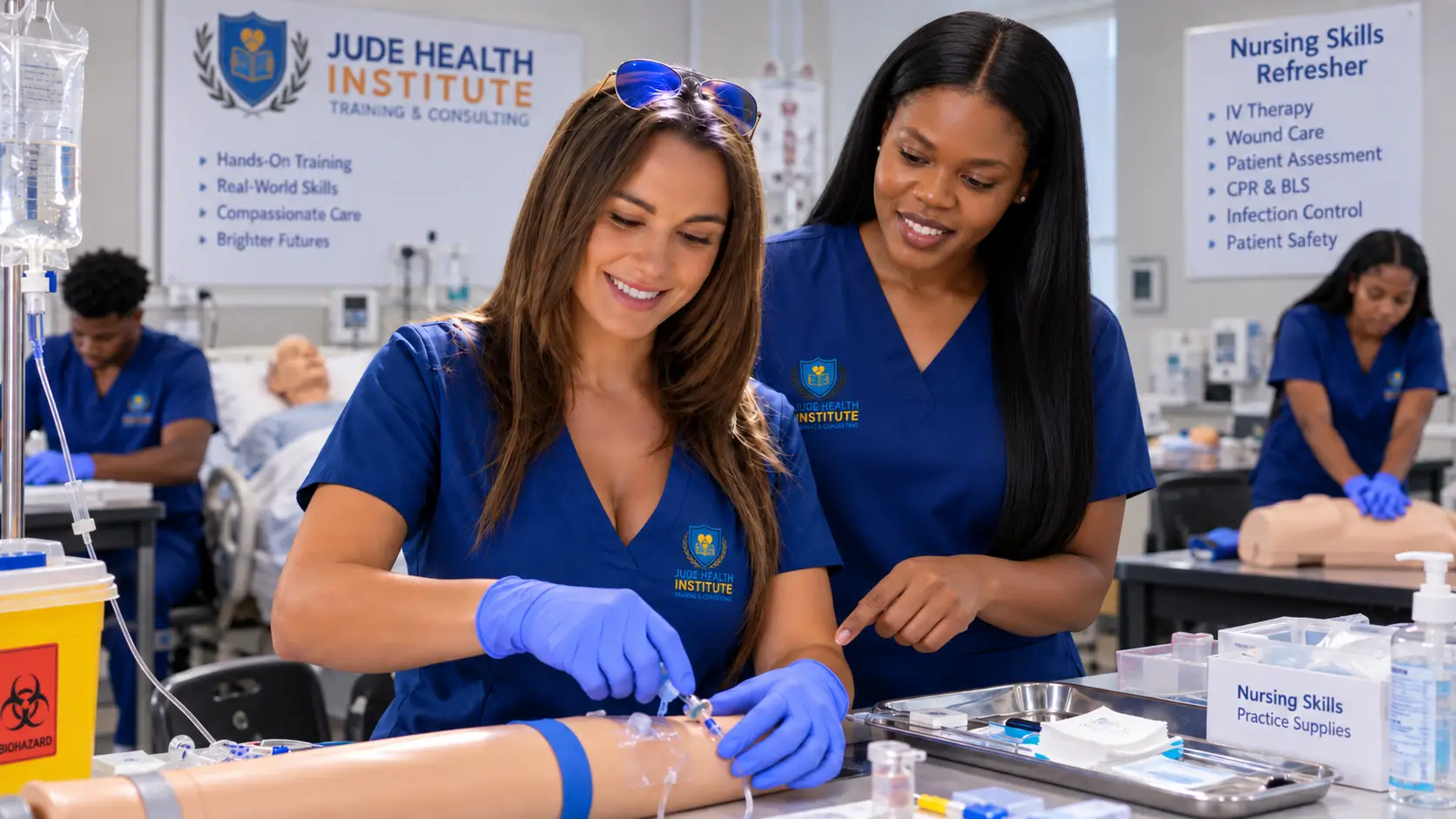
Once the licence side is settled, you may want supervised practice. Our Nursing Skills Refresher is a hands-on nursing skills refresher in Orlando: practice time only, with no CE credit, no clinical hours and no competency sign-off. Tell us what you are returning to and which skills worry you, and we will say honestly whether it fits.
Written by our team
Jude Health Institute
Our guides are written by the team at our Orlando centre on Lake Ellenor Drive. Every regulatory statement names its primary source, and requirements change, so confirm your own before you rely on anything here.
Have a question about your situation?
We will talk it through with you, with no pressure and no obligation.
Common questions
Not always. Florida requires a Board-approved remedial course only in set situations, such as a licence inactive for five years or more with no active licence in another state, three NCLEX failures or a Board order. Outside those, a refresher is your choice, though many returning nurses find hands-on practice helps at interview and in the first weeks.
Rule 64B9-6.003 applies the remedial course requirement to licensees who do not hold an active licence in good standing in another state. If you do hold one, that requirement should not apply, but the reactivation fee and CE still will. Ask the Board to confirm your position in writing before you rely on it.
No. Florida law allows you to practise only on an active status licence. Wait until your record shows active before you accept a start date.
Section 464.008 requires a Board-approved remedial course before you can be approved to test again, and you must apply for re-examination within six months of finishing it. The Board’s page says candidates in this position need a letter from the Board office before they begin the course. Jude Health Institute does not offer remedial courses.
No. It is a simulation-based skills workshop. It is not accredited or state-approved, is not on the Board’s approved remedial course list, gives no CE credit or clinical hours and provides no competency sign-off. It satisfies no Board order, reactivation or remediation requirement.
BLS is usually an employer requirement rather than a licensing one, and many hospital postings ask for a current card from a recognised training organisation. Check each posting and book early. A skills workshop is practice, not certification.
Rarely on its own. The research on skill decay favours short, repeated practice with feedback over a single long session. Use a workshop to find your weak spots, then keep practising them in the weeks before you start.
It can help you perform more steadily at a skills station, but no course can promise a job. Employers make hiring decisions and check competence themselves, through orientation, preceptorship and their own validation.
Yes, briefly and without apology. Give the reason in one sentence, then spend the rest of your answer on what you have done to prepare and what support you would like at the start. Employers are weighing your judgement as much as your history.
Still have a question? Call us at (407) 606-7964.
Keep reading
CNA11 min read
The week before, what to bring, each stage at the test site in order, and what to do if your exam day goes wrong.
 CNA
CNA12 min read
The written test’s five content areas, the 20 skills Prometric can assign, how handwashing and indirect care are scored, and how retakes work.
 Continuing education
11 min read
Who needs CE, which subjects are mandatory and when, how hours reach CE Broker, and what to check before you renew a Florida nursing licence.
No obligation · Speak with an advisor
New sessions are forming. Tell us what you need and an advisor will be in touch with confirmed dates, costs and next steps.
9:00am – 5:00pm, Monday to Friday
Two quick steps — tell us what you need, then how to reach you.

JHI Advisor
Jude Health Institute
Talk to an advisor about courses, schedules, costs and your next step. Pick a day to start.
Free · 30 minutes · No obligation